

Look, I get it. You’re staring at your power station’s battery percentage dropping while you’re out boondocking, and you realize your little 100W panel just isn’t cutting it. You need serious juice. That’s where 400 watt solar panels come in.
But here is the harsh reality most manufacturers won’t tell you: You are rarely going to get a full 400 watts. Real-world conditions, heat, angle, and haze eat up efficiency. I’ve seen “400W” panels that struggle to pull 250W on a sunny day.


I research deep into the specifications and real-world user experiences of six of the most popular portable models on the market, to find out which ones are actually suitable for the road and which ones are just expensive paperweights.
6 Best 400 Watt Solar Panels
Here is the breakdown.
| Solar Panel | Type | Weight Feel | Real-World Output | Best For | Biggest Drawback |
| Renogy 400W Suitcase | Rigid Foldable | Heavy & solid | Strong, consistent | RVers & blackout prep | Short cables |
| Generic 400W Suitcase | Foldable | Light | Inconsistent | Casual campers | Often underperforms |
| Renogy 400W Blanket | Solar blanket | Very light | Surprisingly strong | Overlanders & trucks | Setup is awkward |
| Voominhtec 400W | Foldable | Average | Decent for price | Budget RV setups | Cheap stands |
| TPDEFZQ 400W | Foldable | Moderate | Stable in calm weather | Outdoor adventures | Wind sensitivity |
| Greenmagic 400W | Foldable | Average | Okay, not amazing | Entry-level buyers | Needs multiple units |
1. Renogy 400W Solar Panel Suitcase – The Heavy Hitter

If you’ve been in the solar game for five minutes, you know Renogy. They are usually the safe bet. This suitcase model is built like a tank, aiming for that “buy it for life” crowd. It uses a rigid frame design rather than a soft fabric fold, which typically means better longevity.
However, “durable” often means “heavy.” While the charge quality is generally reliable, moving this beast around isn’t exactly a walk in the park. One thing that bugs me is the texture—it’s not smooth, which makes wiping off dust or mud a bigger chore than it should be. Also, for a “premium” product, the frame can feel surprisingly flexy when you’re maneuvering it.
Pros:
- Solid Charging: Generally delivers consistent power compared to cheaper knock-offs.
- Nice Case: Comes with a protective case that actually fits well.
Cons:
- Cable Length: The cables are ridiculously short. You will need to buy an extension cord unless you want your battery sitting in the direct sun with the panel.
- Cleaning: The textured surface traps dirt, which kills efficiency.
2. Kickstands 400W Portable Foldable Solar Suitcase – The Lightweight Contender

Unlike the Renogy above, this generic model focuses entirely on being easy to carry. If your back hurts just thinking about hauling gear, this is appealing. It’s designed to be deployed quickly—unfold, kickstand out, plug in.
But let’s be real about the numbers. While it claims 400 watts, user reports are all over the map. Some users are seeing as low as 30-70 watts even in decent conditions. That is a massive drop-off. It’s cheap and light, but you are gambling on performance. If you just need to top off a phone or a small laptop, it works, but don’t expect to run an AC unit off this.
Pros:
- Super Portable: Very easy to toss in the back of a car.
- Simple Setup: Kickstands are intuitive.
Cons:
- Power Output: Inconsistent. Don’t bank on getting anywhere near the rated 400W.
- Build Quality: Feels flimsy compared to rigid panels.
3. Renogy 400W N-Type Solar Blanket – The Tech Upgrade
Best High-Efficiency Tech
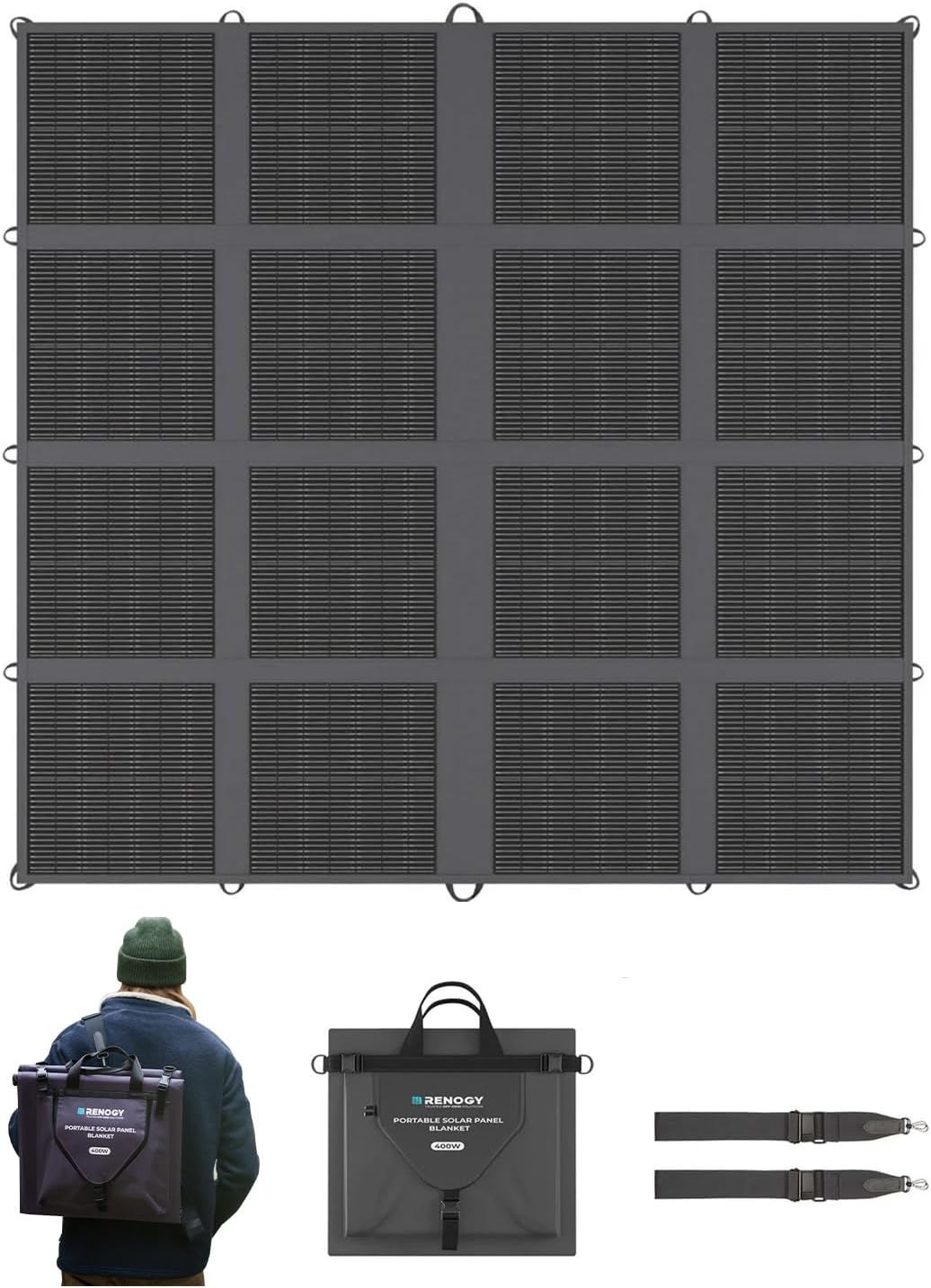
We are back to Renogy, but this is a totally different animal. This is a “blanket” style, meaning it’s soft, flexible, and uses N-Type cells (which are technically more efficient in low light). It packs down incredibly small—16 folds!—making it a space-saver’s dream.
The trade-off? It is floppy. Setting this up by yourself can feel like trying to fold a fitted sheet in the wind. Because it lacks a rigid frame, getting it angled perfectly at the sun is tricky. You often have to drape it over a windshield or tent.
Pros:
- Compact: You can stash this anywhere; great for van lifers with zero storage.
- Tech: N-Type cells tend to degrade slower over time.
Cons:
- Setup: It’s unwieldy. It doesn’t stand up well on its own.
- Adapters: Might need specific adapter cables for non-Renogy batteries.
4. Voominhtec 400W IP68 Waterproof Panel – The All-Weather Choice
Best for Wet Climates
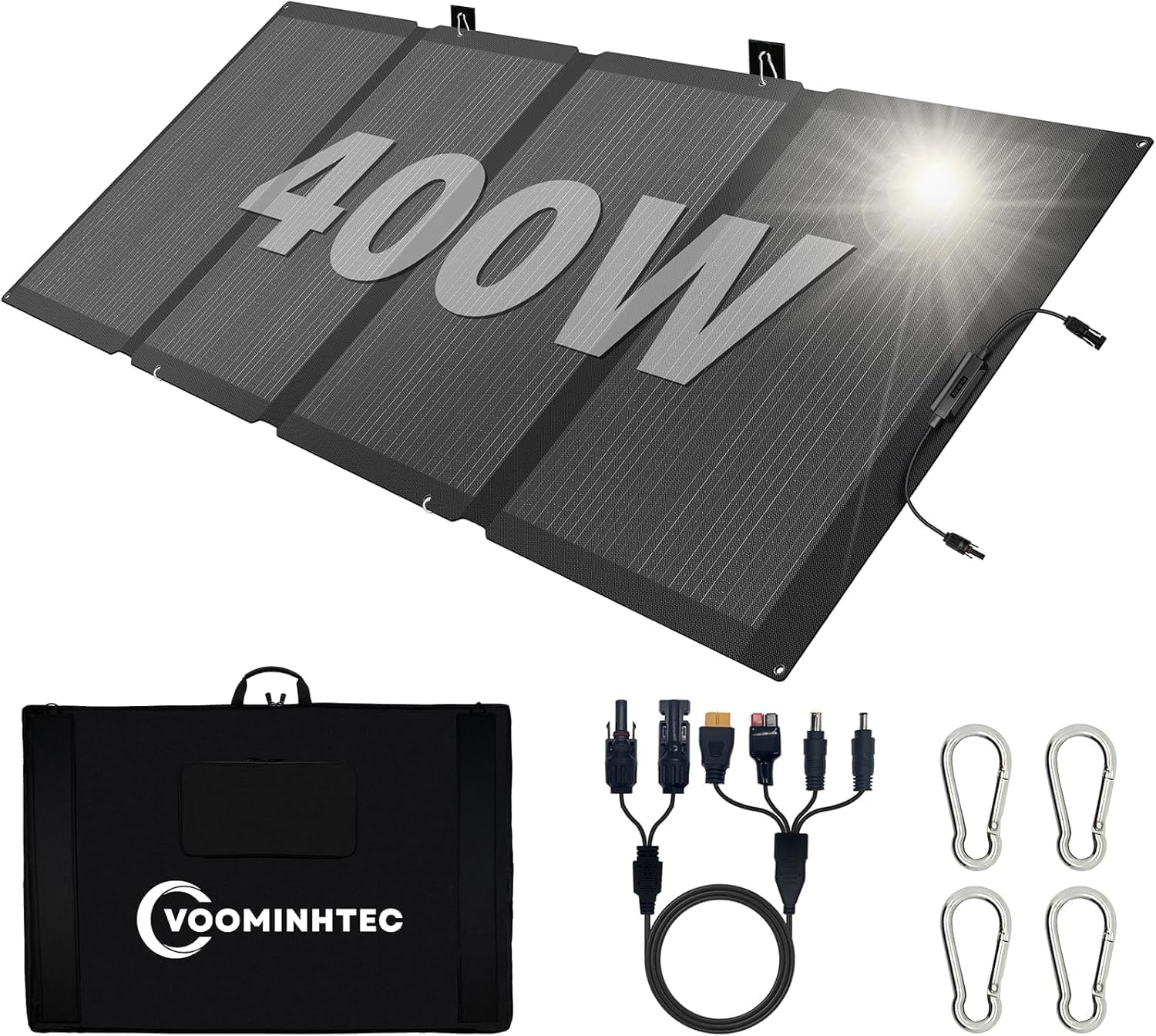
Most portable panels claim to be water-resistant, but Voominhtec claims an IP68 rating, which is pretty substantial. If you camp in the Pacific Northwest or anywhere unpredictable, this is a strong selling point.
Performance-wise, it’s decent. Getting around 240 watts on a hot Texas day (as reported by users) is actually a realistic result for a 400W panel (remember, heat reduces efficiency). It’s not a miracle worker, but it does the job. The weak point here is the hardware. The kickstands feel cheap, and again, we have the curse of the short cables.
Pros:
- Waterproofing: IP68 rating gives peace of mind in sudden rain.
- Decent Output: 240W realistic output is acceptable for this price tier.
Cons:
- Hardware: Kickstands feel like they might snap if you look at them wrong.
- Cables: Once again, too short for practical setups.
5. TPDEFZQ 400W Portable Solar Panel – Good Value for RVers

This is one of those alphabet-soup brand names on Amazon, but don’t immediately write it off. It sits right in the middle of the pack. It uses ETFE coating (a durable polymer), which is better than the cheap PET plastic found on bargain-bin panels.
It works well enough when the weather is calm. However, because it’s a large surface area foldable panel, it catches wind like a sail. If you don’t stake it down or secure it, a gust will send your investment tumbling. It’s a solid backup, but not something I’d leave unattended.
Pros:
- ETFE Coating: resists corrosion and high temperatures better than standard plastics.
- Portability: folds up nicely for RV storage bays.
Cons:
- Wind Stability: Acts like a kite; needs to be secured.
- Generic Feel: Lacks the polish of premium brands.
6. Greenmagic Portable 400 Watt Solar Panel – Best Entry-Level Option

Greenmagic positions this as compatible with most 40V generators. It’s a functional panel, but it suffers from “spec inflation.” Users note that to really charge a normal-sized generator quickly, you’d probably need two of these daisy-chained together.
It’s “nice for the price,” which is code for “don’t expect miracles.” If you just need to keep a 12V battery topped off or run some LED lights at camp, it’s fine. If you are trying to run a remote office, you might be disappointed.
Pros:
- Price: Usually easier on the wallet than Renogy.
- Compatibility: Plays nice with most generic power stations.
Cons:
- Underpowered: A single panel struggles to fully charge larger batteries in a reasonable time.
Buying Guide: What Should You Buy?
Here’s how I’d actually choose:
- If you want dependable power and don’t care about weight:
Go with the Renogy 400W Suitcase. - If space matters more than anything:
The Renogy 400W Solar Blanket is worth the setup hassle. - If you’re on a tight budget:
Voominhtec 400W gives the best bang for your buck. - If you’re just testing the waters:
Start with Greenmagic, but plan to expand later.
Pro Tip: Regardless of which 400 watt solar panels you choose, expect about 60-70% of the rated power on a normal day. If you absolutely need 400W of input, buy two panels.