
When the grid fails, you need a beast that starts on the first pull. We’ve rounded up the heavy hitters. From quiet inverters for camping to massive dual-fuel units that can run your whole house. Here is the no-nonsense list to keep your lights on and fridge cold.
Compare The Best Home Depot Generators
| Generator Model | Wattage | Best For | Fuel Type |
| Power Equipment 4400W | 4400W | RV & Budget Backup | Gas |
| WEN 4,750W | 4750W | Versatile DIYers | Dual Fuel |
| DuroStar DS13000MX | 13,000W | Whole Home Power | Dual Fuel |
| maXpeedingrods 4000W | 4000W | Tech-Savvy Users | Dual Fuel |
| Pulsar G12KBN-SG | 12,000W | Heavy Duty Jobs | Dual Fuel |
| AIVOLT 11250W | 11,250W | High Power & Low Noise | Dual Fuel |
Best Home Depot Generators for Reliable Backup Power
Stop guessing which rig will handle your AC unit. These picks cover everything from tailgating to surviving a week-long blackout without breaking a sweat.
Power Equipment 4400W Inverter
Best for RV & Budget Backup
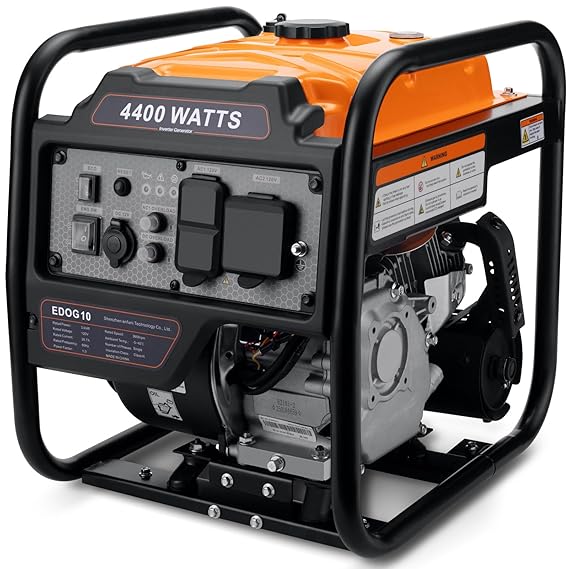
This open-frame inverter is a solid workhorse for those needing clean power without the massive price tag. It’s RV-ready straight out of the box and features an ECO mode to save gas when you aren’t drawing a heavy load. Perfect for keeping the essentials running without waking up the whole neighborhood.
Fast Facts:
- Juice: 4400 Starting Watts / 3500 Running Watts.
- Tech: Inverter technology provides clean power for sensitive electronics like laptops.
- Run Time: Decent tank size for overnight coverage in ECO mode.
Pros & Cons
Pros:
- Lightweight compared to traditional generators.
- ECO mode saves serious cash on fuel.
- Significantly quieter than standard open frames.
Cons:
- Gas only (no propane option).
- Open frame isn’t as quiet as fully enclosed units.
WEN 4,750-Watt Dual Fuel
Best for Versatile DIYers

WEN is known for delivering serious bang for your buck. This dual-fuel unit lets you switch between gas and propane with a turn of a dial—crucial when gas stations run dry during a storm. It comes with a wheel kit, so you aren’t breaking your back moving it around the job site or driveway.
Fast Facts:
- Flexibility: Runs on gasoline or propane (LPG).
- Output: 4750 Surge Watts / 3800 Running Watts (Gas).
- Start: Electric start ensures you aren’t yanking a cord in the rain.
Pros & Cons
Pros:
- Dual fuel offers excellent emergency flexibility.
- Voltage selector allows 120V or 240V output.
- Includes wheel kit and handle for easy transport.
Cons:
- Oil fill location can be a bit tricky to reach.
- Slightly louder than inverter models.
DuroStar DS13000MX 13,000-Watt
Best for Whole Home Power

This is the big boss. With 13,000 watts of peak power, the DuroStar DS13000MX acts like a standby generator at a fraction of the cost. It’s transfer-switch ready, meaning you can plug it directly into your house panel to run central AC, the fridge, and the lights all at once. The remote start is a game-changer on cold mornings.
Fast Facts:
- Powerhouse: 13,000 Peak Watts / 10,500 Running Watts.
- Engine: Massive 500cc engine handles heavy loads effortlessly.
- Convenience: Remote electric start key fob included.
Pros & Cons
Pros:
- Insane power output for whole-home backup.
- CO Alert technology shuts down automatically if carbon monoxide levels get high.
- Remote start is incredibly convenient.
Cons:
- Heavy unit requires muscle to move, even with wheels.
- Thirsty engine consumes fuel quickly at high loads.
maXpeedingrods 4000 Watt Inverter
Best for Tech-Savvy Users

If you love gadgets, this is your pick. It features Bluetooth connectivity so you can monitor fuel levels, load, and run time right from your phone. It’s an enclosed inverter, making it super quiet—perfect for campsites or tailgates where noise restrictions apply. Plus, it’s dual fuel for extra peace of mind.
Fast Facts:
- Smart Control: Bluetooth app for monitoring and remote start.
- Quiet: Fully enclosed casing drastically reduces decibels.
- Parallel Ready: Connect two units to double your power.
Pros & Cons
Pros:
- App control is slick and useful for monitoring remotely.
- Very quiet operation suitable for neighborhoods.
- Clean sine wave power is safe for phones and TVs.
Cons:
- Smaller fuel tank requires more frequent top-ups.
- Bluetooth range can be limited by walls.
Pulsar G12KBN-SG Heavy Duty
Best for Heavy Duty Jobs
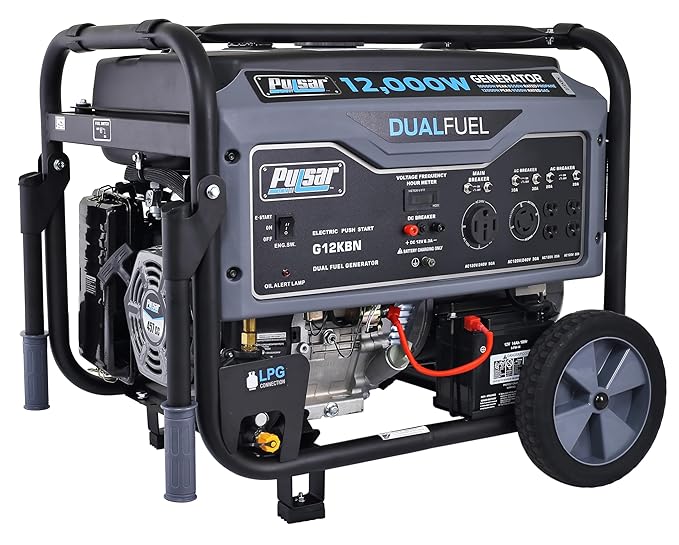
The Pulsar G12KBN-SG is built tough for job sites and serious storms. Pumping out 12,000 peak watts on gas, it has the grunt to run power tools or essential home appliances simultaneously. The rugged frame and never-flat tires mean it can take a beating and keep on running.
Fast Facts:
- Output: 12,000 Peak Watts / 9,500 Rated Watts (Gas).
- Design: Heavy-duty powder-coated steel frame.
- Switch Ready: 50A outlet makes it easy to hook up to a transfer switch.
Pros & Cons
Pros:
- One of the best value-per-watt ratios available.
- Includes a propane hose for immediate dual-fuel use.
- Simple, rugged design is easy to maintain.
Cons:
- It’s loud; definitely not for quiet campgrounds.
- Significant weight makes loading it into a truck a two-person job.
AIVOLT 11250 Watt Inverter
Best for High Power & Low Noise
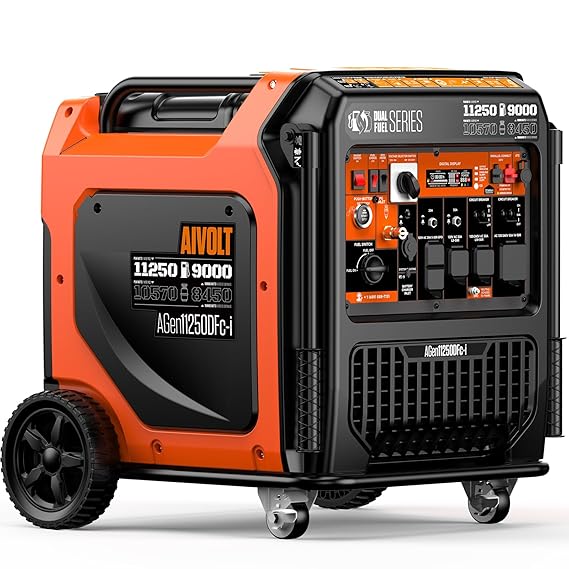
Usually, you have to choose between high power and low noise. AIVOLT changes that. This beast uses inverter technology to deliver massive wattage (11,250W) while keeping the noise levels surprisingly low compared to open-frame generators. It’s the ultimate solution for food trucks or homeowners who don’t want to annoy the neighbors.
Fast Facts:
- Hybrid Tech: High wattage with quiet inverter efficiency.
- Dual Fuel: Runs on Gas or LPG for flexibility.
- Connections: 50A and 30A plugs cover almost all RV and Home needs.
Pros & Cons
Pros:
- Rare combination of high wattage and quiet operation.
- High fuel efficiency adjusts engine speed to load.
- Sleek design with an informative digital display.
Cons:
- Price point is higher due to advanced inverter tech.
- Plastic casing can be prone to scratching if handled roughly.
Pro Tip: What to Avoid
Don’t ignore the “THD” (Total Harmonic Distortion). If you plan to power sensitive electronics like a smart TV, laptop, or furnace control board, avoid standard open-frame generators with high THD (over 5%). Stick to “Inverter” generators (like the maXpeedingrods or AIVOLT above) which produce clean power that won’t fry your expensive motherboard.