

A dead battery is more than an inconvenience; it’s a breakdown waiting to happen. Whether your car sits in the airport parking lot for weeks, your boat bobs at the dock, or your RV awaits the next adventure, a depleted battery can derail your plans. The best solar battery chargers offer a simple, set-it-and-forget-it solution, harnessing the sun’s power to keep your batteries healthy and ready.


This guide compares five of the top-rated models, with real-world pros and cons, buying tips, and FAQs to help you choose the right charger.
Comparison of the Top 5 Solar Battery Chargers
| Product | Wattage | Controller | Waterproof | Best Use Case |
| SUNER POWER 12W | 12W | MPPT | IP65 | Cars, small RVs, and motorcycles |
| SUNER POWER 30W | 30W | MPPT | IP65 | RVs, boats, faster charging |
| ECO-WORTHY 10W | 10W | Basic | 99% Waterproof | Cars, ATVs, tractors |
| Solar Panel Kit 20W | 20W | Upgraded | Yes in Generic | Boats, small RVs, motorcycles |
| SUNAPEX 12V | 12W | Built-in | Water Resistant | Cars, boats, motorcycles |
Why Do You Need a Solar Battery Charger?
Batteries naturally self-discharge over time. In a vehicle that isn’t driven regularly, this can lead to a battery that won’t hold a charge, significantly shortening its lifespan and leaving you stranded.
How solar chargers prevent dead batteries
A solar battery charger provides a steady trickle of power that keeps your battery from discharging over time. This is especially useful for vehicles or boats stored for weeks without use.
Importance of Waterproof and Durable Design
Since these chargers live outdoors, a waterproof and rugged design is non-negotiable. Look for panels with an IP65 or higher rating, which protects against dust and low-pressure water jets from any direction. A durable, scratch-resistant surface will also ensure longevity.
Built-in MPPT Charge Controllers and Why They Matter
This is a critical feature. A charge controller regulates the voltage and current from the solar panel to the battery, preventing overcharging. **MPPT (Maximum Power Point Tracking)** controllers are the most efficient. They optimize the electrical match between the solar panel and the battery, extracting up to 30% more power than older PWM (Pulse Width Modulation) controllers, especially in less-than-ideal light conditions.
Portability and Ease of Setup
The best chargers are user-friendly. They should be lightweight, easy to position on a dashboard or against a windshield, and come with long, well-insulated cables and robust alligator clips or ring terminals for a secure connection. A plug-and-play setup is ideal.
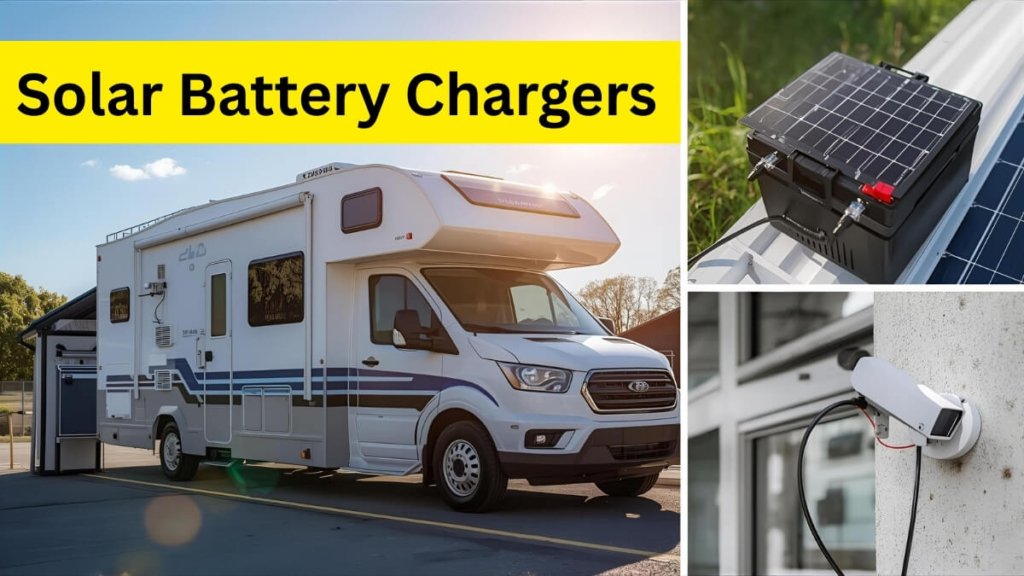
Buyer’s Checklist:
- Correct Wattage: 5W-10W for maintenance, 20W+ for charging.
- Waterproof Rating: IP65 or higher.
- Charge Controller: Built-in MPPT is highly preferred.
- Connection Cables: Long, durable, with secure clips.
- Portability: Lightweight and easy to store.
5 Best Solar Battery Chargers for Cars, Motorcycles, RVs, Boats and Marine
We’ve analyzed user reviews and specifications to bring you the top contenders this year.
1. SUNER POWER Waterproof 12W 12V Solar Battery Charger & Maintainer Pro
This compact panel from SUNER POWER is a powerhouse for maintenance. Its key advantage is the built-in UltraSmart MPPT charge controller, which maximizes efficiency. It’s designed to be a true “set-it-and-forget-it” solution for cars, motorcycles, and lawn tractors. The 12W output is perfect for countering parasitic drain without any risk of overcharging.

Users praise its reliability; one reviewer noted, “Left this on my classic car all winter in the garage (near a window). Fired right up in the spring—battery was perfectly maintained.” The unit is IP65 waterproof and comes with a 10-foot cable, offering great flexibility for placement.
Best For: Standard car, motorcycle, and small equipment battery maintenance.
- Pros: Excellent MPPT efficiency, very durable build, perfect maintenance wattage, long cable.
- Cons: Not suitable for charging large, deeply discharged batteries.
2. SUNER POWER Waterproof 30W 12V Solar Battery Charger & Maintainer Pro
This is the big brother to the 12W model, offering more than double the power. The 30W output makes it versatile enough to maintain larger batteries on RVs, boats, and tractors, and it can even help recharge a partially discharged battery much faster.

It shares the same high-quality features: the UltraSmart MPPT controller and IP65 waterproof rating. If you have a larger battery bank or your vehicle is stored in an area with less direct sunlight, the extra power of the 30W model provides a valuable safety margin.
Best For: RVs, boats, larger automotive batteries, and situations requiring faster charging.
- Pros: Significantly more power, faster charging capability, ideal for large batteries.
- Cons: Bulkier than lower-wattage panels.
3. ECO-WORTHY 10W Solar Car Battery Charger Maintainer
The ECO-WORTHY 10W is a budget-friendly and highly portable option. It’s a straightforward trickle charger designed to prevent battery discharge on cars, trucks, and motorcycles. It features a waterproof design and includes both alligator clips and a cigarette lighter adapter, giving you flexible connection options.

While it may not have the advanced MPPT technology of the SUNER POWER models, it is a reliable and affordable solution for basic maintenance needs. A user shared, “For the price, this little panel is fantastic. Keeps my truck battery full even when I’m away for work for two weeks at a time.”
Best For: Those on a tight budget needing basic maintenance for standard vehicle batteries.
- Pros: Very affordable, includes multiple adapter options, compact and portable.
- Cons: Less efficient than MPPT-equipped models, lower power output.
4. Solar Panel Kit 20W 12V with Adjustable Mount Bracket
This Voltset 20W kit stands out due to its included adjustable mounting bracket. This feature is a significant advantage for permanent or semi-permanent installations on boats, RV roofs, or sheds, allowing you to angle the panel for maximum sun exposure throughout the day.

This kit includes a separate charge controller with an LCD screen that displays charging status, voltage, and current, giving you clear feedback on its performance. The 20W rating offers a great balance between maintenance and charging capability.
Best For: Permanent installations on boats, RVs, or off-grid sheds where optimal angle is key.
- Pros: Adjustable angle for maximum efficiency, informative display, good power output.
- Cons: Not as “plug-and-play” as all-in-one units.
SUNAPEX 12V Solar Battery Charger & Maintainer
The SUNAPEX charger is designed with portability in mind. It’s a lightweight, flexible panel that can easily be rolled up for storage, making it ideal for taking on road trips or using in tight spaces. It has a built-in charge controller to protect your battery.

Its lower wattage makes it best suited for maintaining batteries on motorcycles, ATVs, or lawn mowers during periods of inactivity. It’s a convenient “grab-and-go” option for enthusiasts with multiple seasonal vehicles.
Best For: Motorcycles, ATVs, and as a portable maintenance solution for travel.
- Pros: Highly portable and flexible, easy to store, includes protective diode for basic safety.
- Cons: Not as durable or efficient as rigid monocrystalline panels.
Buying Considerations Before Choosing a Solar Battery Charger
Making the right choice depends on your specific situation.
Matching Charger Wattage with Your Battery Size
As a general rule, a 5W-10W panel is sufficient for maintaining most car and motorcycle batteries (30-70 Ah). For larger deep-cycle batteries found in RVs and boats (100 Ah+), a 20W-30W panel is recommended to effectively combat self-discharge.
Choosing Between Trickle Chargers vs. Faster Charging
If your goal is solely to maintain a battery that is already charged, a trickle charger (5W-10W) is perfect. If you need to occasionally bring a battery back from a low state of charge, a more powerful panel (20W+) will save you significant time.
Seasonal and Climate Considerations
In winter, batteries are more prone to failure, and sunlight hours are shorter. A slightly more powerful panel can compensate for this. In sunny climates, even a basic panel will perform well, but in often-overcast areas, an efficient MPPT controller becomes more valuable.
Budget vs. Long-Term Reliability
While budget options exist, investing in a charger with an MPPT controller and a robust build from a reputable brand often leads to better performance and longer lifespan, providing greater value over time.
Tips for Using Solar Battery Chargers
- Place panels facing direct sunlight for maximum output.
- Always use a built-in charge controller to avoid overcharging.
- Wipe panels regularly to prevent dust from reducing efficiency.
Common Questions About the Best Solar Battery Chargers (With Answers)
How long does it take a solar charger to fully charge a car battery?
solar maintainer is not designed for quick charges. It can take several days of direct sunlight to fully charge a depleted battery with a 10W-20W panel. Its primary function is maintenance.
Can I leave a solar battery charger connected all the time?
Yes, if it has a built-in charge controller. The controller prevents overcharging, making it safe for indefinite connection.
What’s the difference between a solar trickle charger and a solar maintainer?
The terms are often used interchangeably, but a “maintainer” typically implies a smarter device that monitors battery voltage and adjusts output, while a “trickle charger” provides a constant, low current.
Do solar battery chargers work in cloudy weather?
Yes, but with reduced efficiency. They may only provide 10-25% of their rated capacity under heavy clouds.
Is a built-in charge controller necessary for small chargers?
Absolutely. Even a small panel can overcharge a battery over time, causing damage. A controller is essential for safety.
Can I use one solar charger for multiple vehicles?
Not simultaneously. You would need to disconnect and reconnect it between vehicles.
How do I know which wattage solar charger I need?
For maintenance, use the 1-2 watts per 10 Ah guideline. For example, a 50 Ah battery would be well-maintained by a 5W-10W panel.
Are solar battery chargers safe for lithium batteries?
Only if they are specifically designed for lithium chemistry. Using a standard lead-acid charger on a lithium battery can be dangerous. Always check the manufacturer’s specifications.
Related Post: Top 5 Solar Battery Chargers: User Reviews Inside
Conclusion
Investing in the best solar battery charger can save you from dead batteries, extend battery life, and give peace of mind when traveling or storing vehicles. Whether you need a compact 10W trickle charger for your car or a powerful 30W unit for your RV or boat, the options above cover every scenario.