

Most “Educational” toys end up collecting dust because they’re boring or too flimsy. We’ve narrowed down the field to the heavy hitters that actually stick. Whether you’ve got a toddler who loves felt stickers or a pre-teen looking to build a real estate empire on Mars, these picks bridge the gap between “school work” and “game night.”
Top Rated Solar Education Board Games
| Games | Best For | Age Range | Key Material | Main Draw |
| Little Astronauts | Family Race | 4+ | Cardboard/Plastic | High replay value |
| SolarQuest | Strategy Buffs | 12+ | Deluxe Board | Monopoly-style depth |
| Science Can Model | Visual Learners | 3+ | Electronic Model | Talking planet facts |
| Astro Racers | Quick Rounds | 5+ | Game Board | Skill-building speed |
| OKOOKO Felt Set | Creative Play | 4+ | Large Felt | 41-piece storytelling |
| Wooden Planet Puzzle | Montessori Fans | 3-5 | Wood | Durable sensory play |
| BONNYCO Felt Board | Birthday Gifts | 3-8 | Felt | Massive 61-piece set |
| SYNARRY Puzzles | Toddler Logic | 3-6 | FSC Wood | 3-in-1 combo value |
Score Big With The Best Solar Education Board Games
Finding a game that survives a rough-and-tumble playroom while teaching orbital mechanics isn’t easy. You want pieces that don’t go missing the second they hit the carpet and info that’s actually accurate. These picks turn your living room into a launchpad without the rocket-science price tag.
Little Astronauts Race Game

This is a killer entry-level strategy game that won’t make parents want to pull their hair out. It’s a straight-up race through the cosmos where kids learn the order of the planets while trying to outrun their siblings. The board is bright, the rules are “learn-as-you-go,” and it’s built for little hands.
Features a durable folding board and rocket tokens designed for younger players. It focuses on basic counting and celestial recognition, making it a solid “first” board game for the preschool crowd.
Wins & Wobbles
Pros:
- Simple enough for 4-year-olds to play solo.
- Encourages turn-taking without being overly competitive.
- Vibrant artwork keeps kids engaged.
Cons:
- Might be too simple for older kids (8+).
- Paper components can wear down with heavy use.
Snag this if you want a “no-tears” game night that helps your kid memorize the planets before they even hit kindergarten.
SolarQuest Deluxe Edition Real State Board Game

Think Monopoly but with moons and laser fire. This is the “big kid” version of space exploration where you’re buying up planetary properties and managing fuel. It’s the “beater” of the board game world—built to last and packed with enough complexity to keep adults interested during a long rainy afternoon.
This deluxe version includes metal tokens and “Red Shift” cards that add unpredictable twists to your orbit. It covers 12 major planets and moons, teaching gravity-well physics and resource management in a high-stakes setting.
Out Of This World Or Grounded
Pros:
- Deep strategy that rivals classic economic games.
- Teaches complex concepts like fuel consumption and orbital distance.
- High-quality metal ships feel premium.
Cons:
- Games can run long (90+ minutes).
- Rulebook is dense for younger children.
Buy this if your family loves “marathon” game nights and you want a space theme that actually requires a functioning brain to win.
Science Can Talking Solar System Board Game for Kids
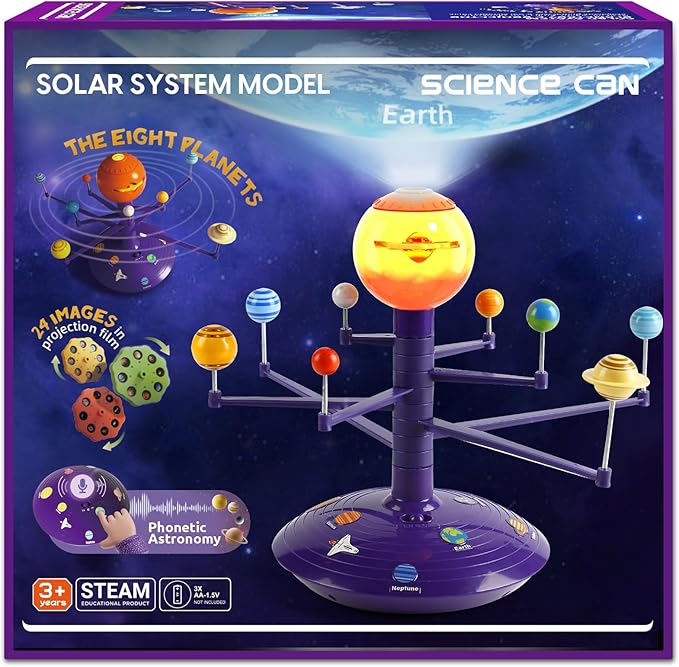
If your kid is a “show me, don’t tell me” learner, this motorized planetarium is the move. It’s a hybrid between a toy and a teaching tool that projects constellations while the base “speaks” facts about each planet. It’s basically a portable museum exhibit for your kid’s nightstand.
Touch the planet icons on the base to hear educational audio in English or Spanish. The sun doubles as a projector with 3 slide discs featuring 24 different space-themed images.
High-Tech Perks & Quirks
Pros:
- Dual-language mode is great for bilingual households.
- Projector function works surprisingly well in dark rooms.
- Compact footprint doesn’t take up the whole desk.
Cons:
- Batteries drain fast if left on overnight.
- Motorized rotation can be a bit noisy.
Get this if you want a toy that pulls double duty as a nightlight and a STEM teacher for a curious toddler.
Astro Racers Strategy Board Game

This is a “pick-up-and-play” gem that balances luck and skill. It’s faster than most space games, making it perfect for those 20-minute windows before dinner. It’s designed to sharpen logical thinking while you navigate asteroid belts and solar flares.
The game supports 2-4 players and uses a colorful board that maps out the entire solar system. It’s a lightweight box that travels well for Grandma’s house or vacations.
Fast Tracks & Roadblocks
Pros:
- Quick setup and even quicker cleanup.
- Rules are intuitive for elementary-aged kids.
- Sturdy board design stands up to spills.
Cons:
- Strategy is limited compared to SolarQuest.
- Art style is a bit “old school” for some.
This is the perfect “filler” game for families who want to squeeze in some learning without committing to a three-hour session.
OKOOKO Giant Felt Story Board Games
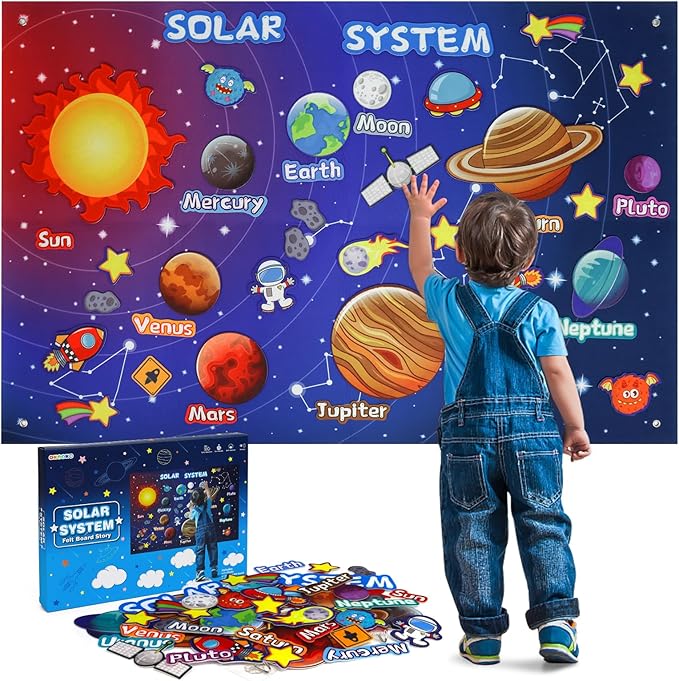
This isn’t just a game; it’s a piece of wall decor that doubles as a classroom. It’s massive—nearly 4 feet wide—and comes with 41 felt pieces that stick anywhere on the background. It’s the ultimate “quiet time” activity for toddlers who love to move things around.
Includes pre-cut planets, astronauts, aliens, and space debris. The set comes with four sturdy hooks so you can hang it on a bedroom wall without ruining the paint.
Soft Play & Sticky Situations
Pros:
- Huge scale makes it a centerpiece for a playroom.
- Great for fine motor skill development.
- Felt pieces are virtually indestructible.
Cons:
- The felt background can arrive creased (needs a quick steam).
- Not a “game” with set rules; requires imagination.
Perfect for the “destructive” age group where cardboard games usually end up ripped. It’s tactile, visual, and looks great on the wall.
Wooden Montessori Planet Puzzle Toy Game for Kids
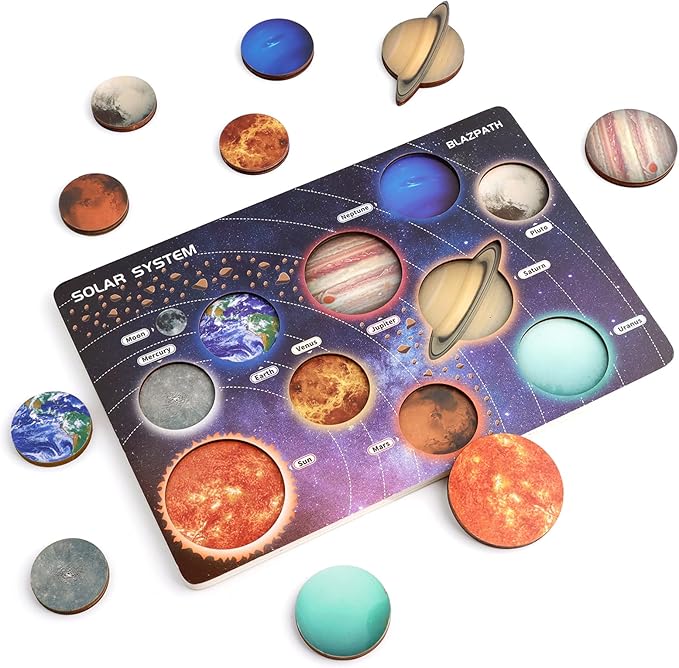
For the Montessori parents out there, this wooden board is the “gold standard.” It’s clean, aesthetic, and teaches the name and position of every planet. The planets are chunky enough for little hands to grip, and the natural wood finish feels way better than cheap plastic.
The board features engraved orbits and labels to help with word recognition. It’s a “movable” model, meaning kids can physically orbit the planets around the sun to understand the layout of our neighborhood.
Natural Vibes & Hard Edges
Pros:
- Sustainable materials with a high-end feel.
- Zero tech/batteries required.
- Double-sided functionality for naming and placing.
Cons:
- Smallest planets can be a choking hazard for under-3s.
- Limited “gameplay” once the puzzle is solved.
Grab this if you value “unplugged” play and want a toy that looks nice enough to leave out on the coffee table.
BONNYCO 61-Piece Felt Universe Board Game

If you liked the OKOOKO but wanted more “stuff,” this is the upgrade. With 61 figures, your kid can basically recreate a NASA mission on their wall. It’s a storytelling powerhouse that covers everything from the Sun to the Kuiper Belt.
Comes with a variety of labels and icons that make it a genuine teaching tool for homeschooling. The figures are distinct and colorful, helping kids differentiate between similar-looking planets like Uranus and Neptune.
Major Missions & Minor Messes
Pros:
- Most pieces per dollar on this list.
- Highly educational with accurate planet details.
- Versatile—can be used on the floor or the wall.
Cons:
- 61 pieces means a lot of stuff to lose under the sofa.
- Velcro can be loud during “quiet time.”
This is the go-to birthday gift for the kid who can already name all the moons of Jupiter. It’s a massive value for the price.
SYNARRY 3-in-1 Wooden Puzzle Box for Kids

This is the “utility player” of the list. You get the Solar System, but you also get the World Map and the USA. It’s a “triple threat” of geography and astronomy in one box. It’s FSC certified, so you know the wood is coming from responsible sources.
Each puzzle is 12.2 x 9.4 inches, making them the perfect size for a standard tray table. The pieces are numbered on the back to help kids who get stuck, which is a total lifesaver.
Triple Value & Small Parts
Pros:
- Excellent “bang for your buck” with three puzzles.
- Environmentally friendly materials.
- Numbers on the back provide a “cheat sheet” for kids.
Cons:
- Puzzles are flat, so they don’t teach “depth” or orbit.
- Box storage can get messy if pieces mix.
Ideal for the “gift closet”—it’s a high-quality, impressive-looking box that any kid in the 3-6 age range will actually use.
Smart Space Shopping
When you’re hunting for a space game, look for scale accuracy. Some games make Earth and Jupiter the same size to save space, which can confuse kids later on. If you’re buying for a classroom, stick with the felt boards—they handle multiple kids much better than a cardboard board game.
Avoid The Battery Trap
Steer clear of electronic models that don’t have an auto-shutoff feature. You’ll find yourself burning through AAs every three days because your “little astronaut” left the sun spinning all night long.
Unless the box specifically mentions “energy saving” or a timer, stick to the analog wooden or felt options.