

Finding the best solar roof panels for trucks is about balancing raw power with the limited real estate on your vehicle. Whether you are building a custom overland rig or just want to keep a fridge running in the bed, the right solar setup provides true independence. Modern N-Type and bifacial technologies have made it easier to generate significant wattage even from small surfaces.
In this guide, we look at top-rated panels that handle the vibrations of the road and the harsh weather of the outdoors. From rigid high-output frames to sleek flexible modules, these picks ensure your truck stays powered up for every adventure.
Best Solar Roof Panels for Trucks
| Panel Name | Wattage | Type | Key Feature |
| STAR 870 Watt Set | 870W | Rigid Monocrystalline | Full-Screen Design |
| Renogy ShadowFlux | 400W | N-Type Rigid | Anti-Shading Tech |
| 400W Flexible Set | 400W | Flexible ETFE | Lightweight & Curved |
| JJN Bifacial Set | 400W | Bifacial N-Type | Dual-Side Charging |
| Renogy 640W Set | 640W | N-Type Rigid | 18BB Cell Efficiency |
| DOKIO 800W Set | 800W | Rigid Monocrystalline | High Voltage Output |
STAR 870 Watt Solar Panel

The STAR 870 Watt set is a powerhouse for large truck builds or heavy-duty trailers. Featuring a unique full-screen design, these panels prevent water and dust accumulation at the edges. This is a massive win for truck owners who don’t want to climb onto the roof for constant cleaning. The 25% efficiency rating is among the highest in the industry, ensuring you get maximum juice from every inch of sunlight.
These panels are built for 24V or 48V systems, making them ideal for high-capacity battery banks. If you have the roof space on a heavy-duty truck or a shell, this maintenance-free design offers long-term reliability. The monocrystalline cells are protected by a rugged frame that handles highway speeds and vibrations without breaking a sweat.
Pros
- Full-screen design prevents dirt buildup.
- Massive 870W total output for high power needs.
- High 25% cell efficiency.
Cons
- Larger footprint requires significant roof space.
- Heavier than flexible alternatives.
Renogy 400 Watt ShadowFlux Anti-Shading Solar Panel
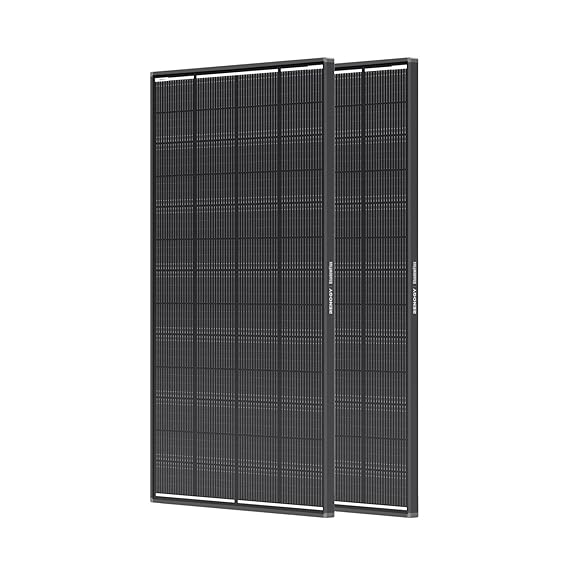
Renogy’s ShadowFlux is a game-changer for trucks that often park under trees or near tall gear. Traditional panels lose significant power when even a small corner is shaded. This N-Type module uses anti-shading technology to keep power flowing even when part of the panel is blocked. This makes it one of the best solar roof panels for trucks used in wooded overlanding spots.
The N-Type construction also means these panels degrade slower over time and perform better in high heat. The blacked-out aesthetic looks sleek on modern truck racks and rooftops. With 16BB (busbar) technology, the internal resistance is lowered, which translates to better energy harvest during those shorter winter days.
Pros
- Exceptional performance in partial shade.
- N-Type cells offer better heat tolerance.
- Sleek, all-black professional look.
Cons
- Higher price point than standard modules.
- Requires a rigid mounting system.
400W Flexible Solar Panel Set for Truck
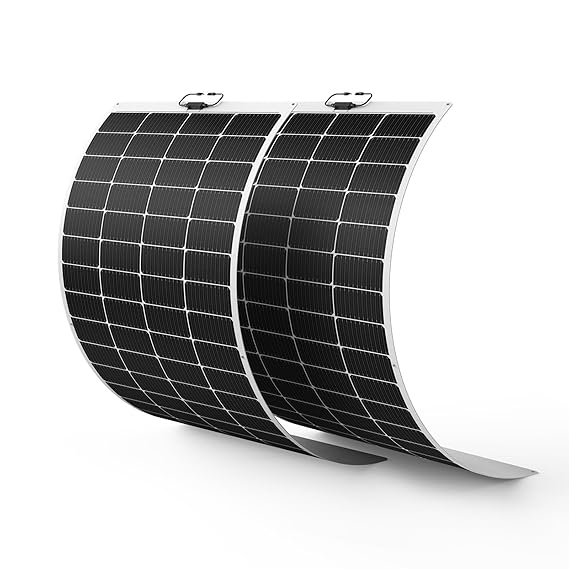
If your truck roof has a curve or you need to keep weight to an absolute minimum, this flexible set is the answer. These panels use premium ETFE lamination, which is much more durable and UV-resistant than cheaper PET plastics. The “cool-running” white design helps reflect heat, keeping the cells at a more efficient operating temperature even when glued directly to a metal roof.
Installation is incredibly simple since you can use high-strength adhesives instead of drilling holes into your truck. They are perfect for mounting on top of a camper shell or a rooftop tent. The low profile also helps maintain your vehicle’s aerodynamics, which can save you a bit on fuel compared to bulky framed panels.
Pros
- Extremely lightweight and low profile.
- Fits curved surfaces perfectly.
- No drilling required for most installs.
Cons
- Shorter lifespan than rigid glass panels.
- Less airflow underneath can cause heat buildup.
JJN Bifacial 400 Watt Rooftop Solar Panel for Truck

Bifacial panels are a smart choice if you have an elevated roof rack. These JJN panels can capture sunlight from both the top and the bottom side. Light reflecting off your white truck roof or a light-colored rack can actually boost your total energy yield. Using N-Type 16BB technology, these modules are designed for high-efficiency energy conversion in various weather conditions.
Because they are bifacial, they use dual-glass construction, making them incredibly sturdy. They are rated for 12V, 24V, or 48V systems, giving you plenty of flexibility for your electrical build. If you have a high-clearance rack where light can reach the underside of the panel, you will see a noticeable jump in daily amp-hours.
Pros
- Extra power gain from reflected light.
- Very durable dual-glass construction.
- High 25% efficiency rating.
Cons
- Needs an elevated rack to utilize the back side.
- Heavier due to the double glass.
Renogy Solar Panels 640 Watts 18BB N-Type

This Renogy 640W kit is designed for those who need a serious balance of power and efficiency. By utilizing 18BB (busbar) technology, these panels maximize the path for electrons, reducing losses and increasing output. The N-Type cells provide a stable power source that doesn’t drop off as much when the sun gets intense and the panels get hot to the touch.
The 320W per panel size is a “sweet spot” for many truck beds and large camper shells. It provides enough energy to run a 12V fridge, lights, and even small power tools without needing a massive array. The black frame and cells offer a stealthy look that blends in well with black powder-coated roof racks.
Pros
- Advanced 18BB technology for better harvest.
- Excellent performance in hot climates.
- Great middle-ground wattage for most builds.
Cons
- Requires sturdy mounting brackets.
- Large panels can be awkward to handle solo.
DOKIO 800W Monocrystalline Solar Panels for Truck Rooftop

The DOKIO 800W set is built for speed and simplicity. With 400W per panel at a 31V output, these are highly effective for charging 24V systems or 12V systems when paired with a quality MPPT controller. The higher voltage helps overcome the voltage drop that can happen over long cable runs from the truck roof to a battery located in the bed.
These panels are standard monocrystalline, which offers a reliable and cost-effective way to get high wattage. They are a bit more traditional in design but very effective for off-grid setups. If you are looking for a straightforward power solution for a work truck or a shed-style camper, this high-wattage pair delivers a lot of value.
Pros
- High voltage is great for long cable runs.
- Reliable monocrystalline performance.
- Massive 800W total for the price.
Cons
- Standard design doesn’t have anti-shade tech.
- Higher voltage requires a compatible MPPT.
How to Choose the Right Solar Power Solution for Your Rig
Selecting the right panel for your truck involves more than just looking at the wattage. You need to consider how you use your vehicle and what kind of environment you’ll be in.
Rigid vs. Flexible Panels
Rigid panels are the gold standard for durability. They are encased in tempered glass and aluminum, making them resistant to scratches from low-hanging branches. They also sit on brackets, allowing airflow underneath, which keeps the panel cooler and more efficient.
Flexible panels are better for curved roofs and keeping the weight low. However, they usually only last 5 to 10 years compared to the 25+ years of a rigid panel.
Understanding N-Type and Bifacial Tech
If you live in the South or West where it gets incredibly hot, N-Type panels are worth the extra investment. They handle high temperatures much better than standard P-type panels. Bifacial panels are excellent if you have a roof rack that leaves the bottom of the panel exposed.
They catch “albedo” light reflecting off your roof, which can add up to 20% more power in the right conditions.
Sizing for Your Battery Bank
Always match your solar output to your battery capacity. A general rule for truck setups is to have at least 100W of solar for every 100Ah of Lead Acid battery, or 200W of solar for every 100Ah of Lithium (LiFePO4) if you use a lot of power.
For those running 12V air conditioners, you will want to maximize your roof space with high-wattage options like the STAR 870W or DOKIO 800W sets.