

Tired of your van adventures being cut short by a dead battery? I’ve been there. Nothing kills the vibe of a perfect boondocking spot faster than having to fire up a noisy generator or drive back to civilization just to charge your phone and keep the fridge running. Choosing the right solar panels for van life isn’t just a technical upgrade; it’s your ticket to true freedom and independence on the open road.


![[Ultra] ECO-WORTHY 1200W 24V 5.52KWH Lithium Battery Solar System Off Grid:6pcs 195W Solar Panels+2P...](https://m.media-amazon.com/images/I/81v18kk9mbL._AC_UY654_FMwebp_QL65_.jpg "[Ultra] ECO-WORTHY 1200W 24V 5.52KWH Lithium Battery Solar System Off Grid:6pcs 195W Solar Panels+2P...")
I learned the hard way that a poorly planned system means lukewarm drinks and late-night scrambles for power. A great setup, however, means waking up to a fully charged battery bank, ready for another day of exploration, powered entirely by the sun. This guide is built from years of on-the-road experience and countless hours of research to help you avoid the pitfalls and build a reliable power system you can trust, whether you’re a weekend warrior or a full-time nomad.
Why Solar Power is a Game-Changer for Van Life
For anyone dreaming of unplugging from crowded campgrounds, solar power is the answer. It’s the silent, clean, and sustainable way to power your mobile life.
What makes solar better than gas generators for van travel?
Unlike loud, smelly, and fuel-dependent generators, a solar system works silently in the background. This is crucial for stealth camping in cities or enjoying the peace of nature. Plus, with no moving parts and minimal upkeep, a well-installed solar system is far more reliable and requires no ongoing fuel costs. As a bonus, it’s a clean energy source that lets you tread a little lighter on the beautiful landscapes you’re exploring.
How full-time vanlifers use solar daily
During my three-month trip through the American West, my solar setup was the unsung hero. It powered:
- My 12V Fridge/Freezer: Kept food fresh 24/7, even during a week-long stay in the Utah desert.
- My laptop and Starlink: Allowed me to work remotely from literally anywhere with a clear view of the sky.
- All amenities: From the ceiling fan that kept me cool at night to the water pump for dishes and the LED lights for reading.
This isn’t just about convenience; it’s about enabling a sustainable lifestyle off the grid.
Understanding Your Van’s Power Needs
Before you buy a single panel, you need to do a little math. The biggest mistake beginners make is either underestimating their needs (leading to dead batteries) or overestimating them (wasting money and roof space).
How to calculate daily energy usage
An energy audit is your first step. List every electronic device you plan to use and estimate its daily run time. The formula is simple:
Watts(W)×HoursofUse(h) = Watt−hours(Wh)
Here’s a sample calculation for a typical day:
| Appliance | Power (Watts) | Daily Hours of Use | Daily Energy (Wh) |
| 12V Refrigerator | 50 W | 8 hours (cycling) | 400 Wh |
| LED Lights (4) | 3 W each (12W total) | 4 hours | 48 Wh |
| Laptop Charging | 65 W | 2 hours | 130 Wh |
| Phone Charging (2) | 10 W each (20W total) | 2 hours | 40 Wh |
| Maxxair Fan | 35 W (on medium) | 5 hours | 175 Wh |
| Total Daily Need | 793 Wh |
Matching power needs to battery bank size (AGM vs Lithium)
Your battery bank is your energy savings account. The total Watt-hours (Wh) you calculated tells you how much energy you need to store.
- AGM (Absorbent Glass Mat): A cheaper, heavier, and proven battery technology. A key drawback is that you can only safely discharge them to about 50% of their capacity.
- Lithium (LiFePO4): The modern standard for van life. They are lighter, last much longer, and you can safely use 80-90% of their rated capacity. While the upfront cost is higher, their longevity and performance make them a better investment.
For our 793 Wh example, you’d need roughly a 130Ah AGM battery (1586Wh/12V≈132Ah) or just an 80Ah Lithium battery (793Wh/(0.9×12V)≈73Ah). The choice is clear for serious travelers.
Amp-hours, watt-hours & voltage simplified
- Volts (V): Think of it as electrical pressure. Most van systems run on 12V.
- Amps (A): The rate of electrical flow.3
- Watts (W): The total power (4Watts=Volts×Amps).5
- Amp-hours (Ah): How much energy a battery can store (e.g., a 100Ah battery can supply 1 amp for 100 hours).
- Watt-hours (Wh): The most accurate measure of energy capacity (Watt−hours=Amp−hours×Volts). Use this for your calculations!
Types of Solar Panels for Van Roofs (Rigid vs Flexible vs Portable)
Your van’s roof shape, your budget, and your desire for stealth will determine the right type of panel for you.
| Panel Type | Pros | Cons | Best For |
| Rigid Panels | Highest efficiency, most durable, longest lifespan (25+ years), best value per watt. | Heavy, require mounting racks, highly visible. | Sprinters, Transits, ProMasters, and skoolies with flat roof space. |
| Flexible Panels | Lightweight, low-profile (stealth), can conform to curved roofs. | Less efficient, shorter lifespan (3-5 years), prone to overheating, easier to damage. | Curved fiberglass roofs, pop-tops, or stealth builds where appearance is critical. |
| Portable Kits | No installation required, can be aimed at the sun for max efficiency, can be used with multiple vehicles. | Must be set up/taken down, risk of theft, less convenient for constant power. | Weekend campers, renters, or those who don’t want to drill into their roof. |
Expert Recommendation: For most full-time van builds (like a Sprinter or Transit), I strongly recommend rigid panels. Their durability and 25-year performance warranty provide peace of mind and the best long-term return on investment.
Best Solar Panel Kits for Van Life
After testing and researching dozens of options, these are the kits I consistently recommend to fellow builders. They offer the best balance of performance, reliability, and value.
1. Renogy 200W 12V Solar Starter Kit – Trusted for First-Time Vanlifers

Renogy Comes with two 100W monocrystalline panels, a 30A PWM charge controller, mounting Z-brackets, and all necessary cables. It’s an all-in-one package designed for beginners.
- Pros & Cons:
- Pros: Extremely popular and well-tested in the van life community. High-efficiency monocrystalline cells. The kit format simplifies the buying process. Great value for the price.
- Cons: The included Wanderer PWM controller is less efficient than an MPPT controller. Some users report needing to buy slightly longer cables for certain van layouts.
2. EcoFlow 220W Portable Solar Panel + River 2 Pro Power Station Combo – Ideal for Flexibility

A bifacial (two-sided) portable solar panel captures ambient light from the back for up to 25% more energy. Paired with the River 2 Pro, a powerful 768Wh LiFePO4 power station with multiple AC, DC, and USB outlets.
- Pros & Cons:
- Pros: Ultimate plug-and-play solution. No complex wiring or installation. The power station has an extremely fast recharge time (0-100% in 70 mins via AC). The portable panel is highly efficient and durable.8
- Cons: Higher cost per watt compared to a permanent DIY system. The panel is a target for theft if left unattended.9 You’re dependent on the single power station unit.
- Ratings: 4.4 out of 5 stars from over 700 ratings.
- Warranty & Certs: 5-year warranty for the power station. Panel has an IP68 weatherproof rating.
3. Topunive 200W Flexible Panel Kit – Great for Curved Roofs

Two ultra-thin, lightweight 100W flexible panels that can bend up to 248 degrees. The kit includes a 20A MPPT charge controller, which is a significant upgrade over standard PWM controllers.
- Pros & Cons:
- Pros: Excellent for stealth builds as it lays nearly flat against the roof. Very lightweight, making it suitable for pop-tops or vans with payload limits. The included MPPT controller maximizes power generation.
- Cons: Flexible panels have a shorter lifespan and are more susceptible to damage from impacts (like tree branches) than rigid panels. Performance can degrade if they get too hot without proper airflow underneath.
4. Jackery Solar Generator 1000 Plus Kit – Plug-and-Play Portable Power
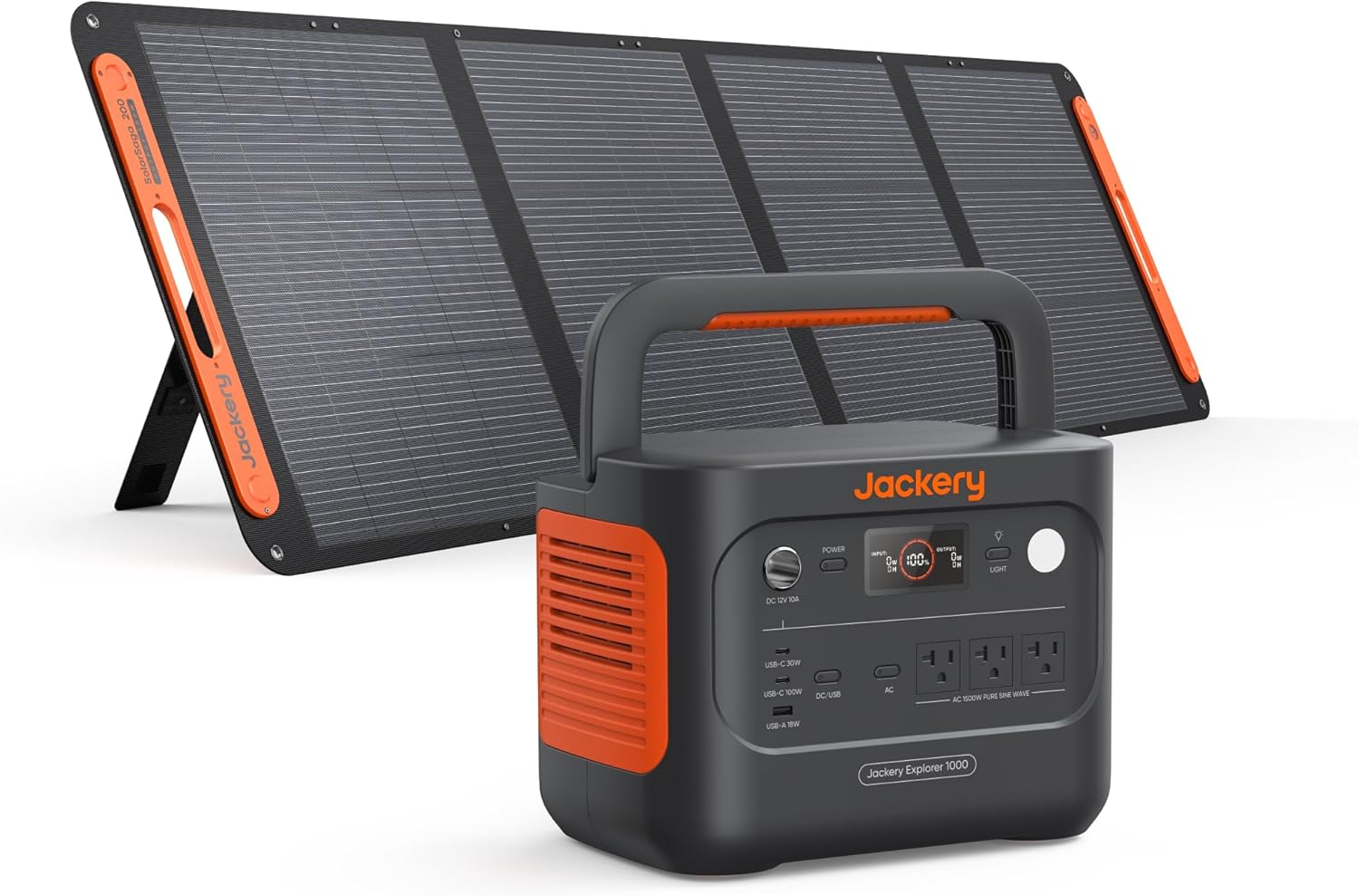
Key Features: A complete system with a 1264Wh LiFePO4 power station and two 100W SolarSaga panels. The power station is expandable up to 5kWh with additional battery packs. Features multiple output ports and a clear LCD screen.
- Pros & Cons:
- Pros: Extremely user-friendly—it’s the “Apple” of portable power. The system is robust, well-built, and backed by a reputable brand. Expandability is a huge plus for future-proofing your power needs.
- Cons: Premium price point. The proprietary connectors can limit compatibility with third-party components.
Brief comparison of solar panel performance for van life
| Product | Wattage | Type | Key Feature | Best For |
| Renogy 200W Kit | 200W | Rigid Kit | Best overall value | DIY beginners |
| EcoFlow River 2 Pro Combo | 220W | Portable Station | Ultra-fast charging | Flexibility & portability |
| Topunive 200W Kit | 200W | Flexible Kit | Includes MPPT controller | Curved roofs & stealth |
| Jackery 1000 Plus Kit | 200W | Portable Station | Expandable battery | Premium plug-and-play |
How Much Solar Do You Really Need? (Wattage & Cost Breakdown)
Your solar needs depend entirely on your lifestyle.
| User Type | Typical Power Needs | Recommended Solar | Estimated System Cost |
| Weekend Warrior | Lights, fan, phone/laptop charging | 100W – 200W | $300 – $700 |
| Full-Time Nomad | All of the above + fridge, water pump, etc. | 300W – 600W+ | $1,200 – $3,500+ |
BLM (Bureau of Land Management) Boondocking Considerations: When you’re staying on public lands for extended periods, you are your own power company. I recommend aiming for at least 400W of solar and a 200Ah lithium battery for full-time off-grid living. This gives you enough buffer to get through a couple of cloudy days without power anxiety.
DIY Solar Panel Installation vs Buying a Kit: Pros & Cons
DIY Installation:
- Pros: Full customization, potential to save money, deeper understanding of your system.
- Cons: Requires research, proper tools, and electrical knowledge. Mistakes can be costly or dangerous.
Pre-Wired Kits (like Jackery/EcoFlow):
- Pros: No installation risk, saves a huge amount of time, components are guaranteed to work together, covered by a single warranty.
- Cons: Less customization, higher cost per watt, reliant on a single unit.
Mistakes to Avoid During Van Solar Installs:
- Using the wrong wire gauge: Too-thin wires can overheat and cause a fire.
- Forgetting fuses: Always install fuses between your panels and controller, and between your controller and battery. I learned the hard way that skipping surge protection fries your ports—don’t risk it!
- Poor panel mounting: Not using enough sealant or the correct hardware can lead to leaks or a panel flying off on the highway.
- Bad panel placement: Placing panels where a vent fan or roof rack will shade them will severely impact their performance.
Quick Recap – Choosing Solar Panels for Van Life
- Best for Beginners: The Renogy 200W Starter Kit is a proven, affordable entry point.
- Best for Portability: The EcoFlow River 2 Pro Combo offers incredible flexibility without permanent installation.
- Best for Stealth: The Topunive Flexible Kit is perfect for curved roofs and staying low-profile.
- Don’t Forget: An MPPT charge controller and a lithium (LiFePO4) battery are the two most impactful upgrades for any serious van life solar setup.
Your choice should match your travel style. If you’re building a full-time rig, go with a robust rigid panel system. If you’re a weekend adventurer, a portable power station might be all you need.
FAQs – Solar Panels for Van Life
How many solar panels do I need to live full-time in a van?
Most full-timers run between 300W and 600W of solar. This is usually enough to power a fridge, lights, fan, and charge electronics daily, with a buffer for cloudy days.
Can I install panels on a fiberglass or curved roof?
Yes. Flexible solar panels are designed for this exact purpose. They can be mounted directly with a strong adhesive like 3M VHB tape and a weatherproof sealant like Dicor Lap Sealant.
What’s the difference between PWM and MPPT charge controllers?
PWM (Pulse Width Modulation) is an older, simpler technology that acts like a switch.16 MPPT (Maximum Power Point Tracking) is a more advanced technology that actively finds the optimal voltage and amperage to maximize power harvest, making it up to 30% more efficient.17 For the extra $50-$100, MPPT is always worth it.
How long does a solar panel system last on a van?
High-quality rigid solar panels have a performance warranty of 25 years. Flexible panels have a much shorter lifespan, typically 3-5 years.18 The electronics (charge controller, inverter) and batteries will likely need to be replaced sooner, usually within 5-15 years depending on the type and quality.
Do flexible solar panels get too hot?
Yes, this is a common issue. Since they are often mounted directly to the roof, they lack airflow and can overheat, which reduces their efficiency and lifespan. Some users create a small air gap to mitigate this.
Can I add more panels later if my needs grow?
Yes, but you need to plan for it. Make sure your initial charge controller can handle the additional amperage. When adding panels, it’s best to use panels with identical voltage and wattage ratings.
What’s the best battery to pair with van solar?
LiFePO4 (Lithium Iron Phosphate) batteries are the gold standard for van life due to their long lifespan, light weight, safety, and deep discharge capability.19
Do I need an inverter for small appliances?
Yes. Your solar system produces 12V DC power. If you want to power standard household items with a regular plug (like a laptop charger or a blender), you need an inverter to convert 12V DC to 120V AC.20
Is it legal to park and charge via solar anywhere in the U.S.?
Generally, yes. If you are legally parked, you can use your solar panels. This is one of the great advantages for boondocking on public lands like BLM or National Forests, as well as stealth camping in cities where generator use is prohibited.
How do I maintain my solar panels while traveling?
Maintenance is minimal. Simply wipe them down with a soft cloth and water every few weeks to remove dust, dirt, or bird droppings, as this can impact their efficiency. Check wiring connections for tightness once a year.