
Best Direction for Solar Panels: The Complete Guide to Panel Orientation
You’ve got your system sized. You know your peak sun hours. You’ve calculated your tilt angle. Now comes the question that ties everything together — which direction should your panels actually face?
And here’s the first thing to get straight: of all the variables in solar panel installation — tilt angle, panel wattage, inverter efficiency, battery size — panel direction (azimuth) has the single biggest impact on how much electricity your system actually produces. More than tilt. More than panel brand. More than almost anything else you can control.
EnergySage puts it plainly: “The direction is more important than the angle.” A panel facing the wrong direction loses 15–30% of annual output. That same panel at a suboptimal angle loses only 5–10%.
So let’s settle this completely. By the end of this guide, you’ll know exactly which direction your panels should face, why it matters, how much output you lose for every degree you deviate, and what to do if your roof doesn’t cooperate.
The Short Answer
Northern Hemisphere (USA, Canada, Europe, most of Asia):
Face your panels true south.
Southern Hemisphere (Australia, South Africa, South America, New Zealand):
Face your panels true north.
That’s the core rule. Everything else in this guide is nuance — important nuance, but nuance. If you remember nothing else, remember: south in the north, north in the south.
Why Direction Matters More Than Angle
Here’s the physics behind why direction dominates angle in its impact on solar output.
The sun moves across the sky in an arc — rising in the east, crossing the sky through the south (in the northern hemisphere), and setting in the west. A south-facing panel in the northern hemisphere is facing the center of that arc — it receives direct sunlight for the maximum number of hours each day, from mid-morning through mid-afternoon.
An east-facing panel only gets direct sun in the morning. A west-facing panel only gets it in the afternoon. A north-facing panel barely catches the sun at all — it’s facing away from the arc the sun travels.
Tilt angle, by contrast, determines how directly the sun hits the panel during the hours it does receive sun. Adjusting tilt from optimal to suboptimal shifts the angle of incidence somewhat — but the panel still receives sun for roughly the same number of hours. Direction shifts which hours (and how many total hours) the panel is in direct sunlight. That’s a far bigger variable.
The Department of Energy confirms: south-facing panels at 15–40° tilt is the sweet spot for maximum output in the continental US.
True South vs. Magnetic South — A Critical Difference
This is the detail most people miss — and it can cost you 1–3% of annual energy production if you don’t account for it.
When you pull out a compass to find “south,” the needle points to magnetic south — which is not the same as true south (also called geographic south or astronomical south). The difference between the two is called magnetic declination, and it varies significantly across the US:
- East Coast: Magnetic declination is roughly 10–14° West — meaning a compass points about 10–14° west of true north/south
- West Coast: Magnetic declination is roughly 12–16° East — meaning a compass points east of true north/south
- Central US: Near zero declination — compass and true south roughly align
Why this matters: If you’re in Boston and you orient your panels to magnetic south, you’re actually pointing them about 14° west of true south — costing you real energy compared to true south orientation.
How to find your exact magnetic declination:
- Visit ngdc.noaa.gov/geomag/calculators/magcalc.shtml (NOAA’s official tool)
- Enter your address and read the magnetic declination value
- Adjust your compass reading by that amount to find true south
Always instruct your installer to orient panels to true south, not magnetic south. This is standard practice for professional installers who use GPS rather than compasses, but worth confirming explicitly.
South-Facing Panels — Why They Win
Solar panel direction efficiency diagram
South-facing panels are the gold standard for one simple reason: the sun travels from east to west across the southern sky in the northern hemisphere. A south-facing panel sits squarely in the path of the sun’s entire daily arc — catching sunlight from morning through evening with the longest possible exposure at the highest possible intensity.
Here’s what south-facing does for you specifically:
Maximum daily sun hours: A south-facing panel receives direct sunlight for the longest stretch of the day — typically 6–9 hours of meaningful generation depending on season and latitude. East or west-facing panels receive 4–6 hours.
Peak noon production: Solar noon — when the sun is highest in the sky and irradiance is strongest — falls exactly when your south-facing panels are perpendicular to the sun. This is when panels produce the most power per hour.
Year-round consistency: Because the sun always arcs through the south, south-facing panels perform consistently in both summer and winter. The sun gets higher in summer (more perpendicular to a low-tilt south-facing panel) and lower in winter (more perpendicular to a higher-tilt south-facing panel). Either way, the south-facing direction keeps you in the sun.
The DOE confirms: South-facing panels at appropriate tilt consistently outperform all other orientations for annual total energy production in the continental US.
West-Facing Panels — The Time-of-Use Advantage
West-facing panels produce approximately 10–15% less total annual energy than south-facing panels. So why are some California and Australian installers recommending them?
Because of time-of-use electricity pricing — and this is one of the most financially important nuances in modern solar design.
In states with TOU tariffs (California’s NEM 3.0, many other utilities), electricity rates vary dramatically by time of day:
- Midday (10 AM–2 PM): Cheapest grid electricity — often $0.10–$0.15/kWh
- Peak evening (4 PM–9 PM): Most expensive — often $0.35–$0.65/kWh
South-facing panels peak at solar noon — when grid electricity is cheapest. West-facing panels peak at 3–6 PM — when grid electricity is most expensive.
Here’s the counterintuitive result: A west-facing panel producing 10–15% less total electricity may deliver equal or better financial return than a south-facing panel, because its production is concentrated exactly when it’s most valuable — offsetting expensive evening peak-rate electricity rather than cheap midday electricity.
When west-facing makes sense:
- Your utility has aggressive TOU pricing with high afternoon peak rates
- You’re on California NEM 3.0 (where export value is very low — keeping solar for self-use at peak times is critical)
- You have battery storage that can absorb west-facing afternoon production
- You have no south-facing roof available but have a good west-facing section
When south-facing remains better:
- Your utility offers flat-rate (non-TOU) pricing — every kWh is worth the same regardless of when it’s produced
- You have net metering with fair export rates
- You’re maximizing total annual energy production for off-grid or whole-home offset
East-Facing Panels — Morning Power
East-facing panels produce approximately 15% less annual energy than south-facing panels — the same loss as west-facing. They capture the morning sun well but miss the more intense afternoon sun entirely.
East-facing works reasonably well when:
- Your only good roof section faces east
- You have a household that uses significant power in the morning (HVAC startup, electric cooking, morning EV charging)
- Combined with a west-facing section in a split east-west system (discussed below)
East-facing panels and TOU pricing: Morning peak rates exist in some utility structures — but they’re far less common and typically less extreme than afternoon peak pricing. The financial TOU advantage that benefits west-facing panels generally doesn’t apply to east-facing as strongly.
The important practical note on east vs. west: West-facing panels consistently outperform east-facing panels slightly — roughly 5% more annual output — because afternoon sun is more intense and lasts longer than morning sun in most locations. When given a choice between east and west for a secondary roof section, choose west.
North-Facing Panels — The Last Resort
North-facing panels are the clear worst option for any northern hemisphere installation — receiving only about 70% of the output of a south-facing panel of the same size and tilt. That’s a 30% production penalty just from direction alone.
Why so bad? In the northern hemisphere, the sun never crosses the northern sky. It always arcs through the south. A north-facing panel is literally pointing away from where the sun spends 95% of its time.
Can north-facing panels ever make sense?
Almost never — but there are narrow exceptions:
- Very low tilt angles (near flat) reduce the north-facing penalty significantly, since a nearly flat panel captures light from all directions through diffuse irradiance. One installer quoted by EnergySage says north-facing makes sense in only “1 out of 1,000 installs.”
- In extremely high electricity rate environments (parts of California, Hawaii), even 70% output can still deliver positive ROI if there’s absolutely no other viable roof section.
- Northeast or northwest facing is meaningfully better than true north — the sun clips these orientations in the morning or evening respectively.
The bottom line: Avoid north-facing as a primary installation. If your only roof is north-facing, explore ground mounts, carport mounts, or east/west side roof sections before committing to north-facing panels.
The Output Loss Table — Every Direction Compared
Here’s the complete picture — how much annual energy output you lose at each compass direction relative to optimal south-facing, for a typical US location at standard tilt:
| Direction | Azimuth Angle | Annual Output vs. True South | Output Loss |
|---|---|---|---|
| True South | 180° | 100% | — |
| South-Southwest | 195° | 99.5% | −0.5% |
| South-Southeast | 165° | 99.5% | −0.5% |
| Southwest | 225° | 94–96% | −4–6% |
| Southeast | 135° | 94–96% | −4–6% |
| West-Southwest | 247.5° | 90–92% | −8–10% |
| East-Southeast | 112.5° | 90–92% | −8–10% |
| West | 270° | 85–90% | −10–15% |
| East | 90° | 85–90% | −10–15% |
| North-Northwest | 337.5° | 75–80% | −20–25% |
| North-Northeast | 22.5° | 75–80% | −20–25% |
| North | 0° | 70–72% | −28–30% |
Key insight from this table: The output loss curve is not linear — it’s gentle near south and steep near north. Panels anywhere between southeast (135°) and southwest (225°) retain 94–100% of south-facing output. That’s a generous 90° window where performance is excellent. Only when you get beyond east or west does performance drop significantly.
Practical implication: If your roof faces slightly southwest or southeast — don’t panic. You’re losing less than 6% of output compared to perfect south. That’s completely acceptable and far better than most people assume.
East-West Split Systems — A Smart Compromise
Here’s a solar system design that more homeowners should know about: the east-west split array.
Instead of putting all panels on one south-facing roof section, you install panels on both the east-facing and west-facing slopes of a standard peaked roof.
How it works: East-facing panels produce well in the morning (7 AM–noon). West-facing panels produce well in the afternoon (noon–6 PM). Combined, the system produces a flatter, more spread-out daily production curve — generating reasonable output across a longer daily window rather than a sharp midday peak.
The trade-off: Total annual energy production is roughly 10–15% less than an equivalent all-south system. But the flatter production profile has significant advantages:
- Better self-consumption: Production is spread across more hours, matching household consumption patterns more closely throughout the day
- Less midday export waste: Under low-export-rate policies (NEM 3.0), a flatter curve means less energy exported at low value during the midday peak and more used directly
- Better battery charging strategy: Batteries can absorb the morning east-panel production and then afternoon west-panel production more effectively than handling one large midday burst
- More roof space utilization: You fill both sides of the roof rather than just the south face
- Reduced peak inverter loading: Spreads the production load more evenly across the day, reducing peak demand on the inverter
East-west systems are particularly popular in Germany, Australia, and the Netherlands where flat electricity rates, dense roof environments, and self-consumption incentives make the spread-out production profile financially attractive. Under California’s NEM 3.0, the east-west design is increasingly being recommended by installers.
How Roof Orientation Affects Your Options
Most homeowners don’t get to choose their roof orientation — the house is already built and the roof faces whatever direction it faces. Here’s how to handle every common scenario:
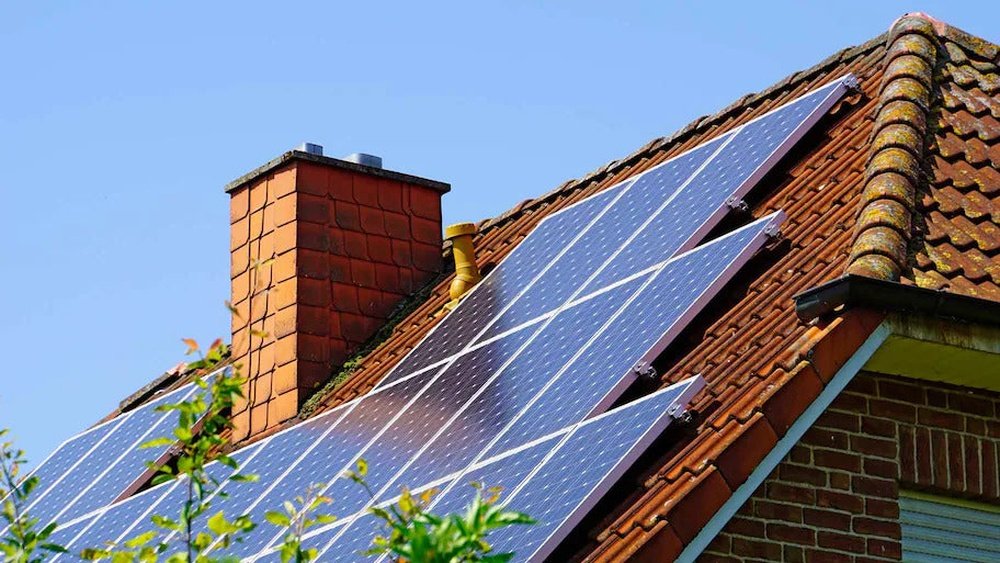
South-facing primary slope: You’re in the ideal situation. Mount panels flush on the south slope at whatever tilt the roof provides. As long as your roof pitch is between 15° and 40°, you’re in the DOE’s Goldilocks zone.
East-west peaked roof (ridge runs north-south): Classic situation for an east-west split system. Put panels on both slopes. Consider weighting more panels toward the west slope if you have TOU pricing with high afternoon rates.
North-south peaked roof (ridge runs east-west): One slope faces south (great), one faces north (avoid). Put all panels on the south-facing slope. If the south slope is too small, consider the east and west ends of the roof.
Flat roof: You have total freedom. Mount panels on tilt frames facing true south at your optimal latitude angle. The flat roof is actually an advantage — you’re not constrained by the roof’s fixed pitch or direction.
Northeast or northwest facing primary slope: You’re in the “okay but not ideal” zone. A northeast or northwest facing roof loses roughly 20–25% of potential output. Install panels here if it’s your best option — the economics still work in most US markets, just with a longer payback period. Use a lower tilt angle to reduce the directional penalty.
True north facing primary slope: Explore alternatives first — ground mount, carport, east/west secondary sections. If north-facing is truly the only option, use a very low tilt angle (10–15°) to minimize the north-facing penalty.
Southern Hemisphere — Everything Flips
If you’re in Australia, South Africa, New Zealand, South America, or anywhere south of the equator, the rule completely reverses:
Face panels true north in the Southern Hemisphere.
The reason is the same physics, mirrored. In the southern hemisphere, the sun arcs across the northern sky — rising northeast, crossing through north, setting northwest. North-facing panels sit squarely in the sun’s path all day. South-facing panels point away from the sun.
Southern Hemisphere rules:
- Best direction: True north (0° azimuth)
- Good alternatives: Northeast, northwest (within 45° of true north)
- Acceptable: East or west (15% production loss)
- Avoid: True south (southern hemisphere equivalent of north-facing in the US — 30% penalty)
Everything else in this guide applies identically — the optimal tilt angle equals latitude, the seasonal summer/winter adjustment formula works the same way, and the output loss table mirrors perfectly with north and south swapped.
Direction + Tilt Angle — The Combined Effect
Now let’s bring direction and tilt together — because the two interact to determine your total effective peak sun hours capture.
From the previous article in this series, we established that wrong tilt angle reduces your effective PSH. Wrong direction does the same. Wrong both together compounds the damage significantly.
Combined output for direction + tilt combinations at 40° N latitude:
| Direction | Optimal Tilt | Non-Optimal Tilt (20°) | Flat (0°) |
|---|---|---|---|
| True South, 40° tilt | 100% | 88% | 72% |
| Southwest/Southeast | 96% | 85% | 70% |
| West or East | 87% | 79% | 67% |
| North-Northwest/Northeast | 78% | 70% | 65% |
| True North | 70% | 65% | 62% |
The worst combination — north-facing at 0° flat — captures only 62% of the output of a properly oriented south-facing system at optimal tilt. That’s nearly 40% of available energy permanently left on the table from orientation and tilt choices alone.
The best non-south combination — southwest or southeast at optimal tilt — captures 96% of south-facing optimal output. The 4% loss is negligible in real-world terms — less than the typical year-to-year variation in weather.
The takeaway: Prioritize getting direction right first (south or close to it), then optimize tilt angle second. A south-facing panel at suboptimal tilt massively outperforms a perfectly tilted panel facing north.
What If Your Roof Isn’t Ideal?
Here’s the reassuring real-world truth: most American roofs are good enough for solar. EnergySage states directly that “your roof is probably just fine for solar.”
Here’s why:
The most common US residential roof — a standard gable with slopes facing roughly southeast and southwest, or south-facing primary slope at 4:12–6:12 pitch — sits comfortably within the productive zone. As long as you’re anywhere between southeast (135°) and southwest (225°), you’re retaining 94–100% of ideal output.
What actually kills solar economics more than suboptimal direction:
- Heavy shading from trees, chimneys, or neighboring buildings — shading is far more damaging than suboptimal direction
- Small roof area that limits how many panels you can install
- Bad net metering or export policies in your state or utility territory
- Very low local electricity rates that reduce the financial value of each kWh produced
If your installer tells you your orientation is problematic, ask them to run an actual PVWatts simulation for your specific address and show you the estimated annual production numbers. Real data beats general rules every time — and you might be surprised how productive a “non-ideal” orientation actually is when modeled with precise irradiance data.
Frequently Asked Questions
What is the best direction for solar panels in the US?
True south is the best direction for solar panels anywhere in the continental United States. South-facing panels receive the maximum number of daily sun hours because the sun arcs across the southern sky in the northern hemisphere. Any direction between southeast (135°) and southwest (225°) retains 94–100% of true south output — so a roof that faces slightly off-south is perfectly fine.
Do solar panels have to face south to be worth it?
No — but south is optimal. East or west facing panels produce approximately 10–15% less annual energy than south-facing, which extends payback period somewhat but doesn’t kill the economics — especially in high-electricity-rate markets. The only truly problematic orientation is north-facing, which loses about 30% of potential output. Even then, in premium electricity markets like California or Hawaii, north-facing can still deliver positive ROI with the right system design.
Is west or east better for solar panels?
West is slightly better than east — producing roughly 5% more annual energy. This is because afternoon sun is slightly more intense and lasts longer (relative to atmospheric losses) than morning sun. West-facing panels also have a financial advantage under time-of-use electricity pricing, since they generate power during the expensive late-afternoon peak rate window rather than the cheaper morning hours.
What is azimuth angle for solar panels?
Azimuth angle is the compass direction your panels face, measured clockwise from true north. True south = 180° azimuth in the northern hemisphere — the target direction for maximum solar production. True east = 90°, true west = 270°, true north = 0° or 360°. When a solar installer or PVWatts calculator asks for “azimuth,” they want this 0–360° compass bearing referenced from true north.
Should solar panels face true south or magnetic south?
Always true south — not magnetic south. The difference between the two (called magnetic declination) can be as large as 15–20° in parts of the US. In Boston, magnetic south is actually about 14° west of true south — orienting to magnetic south rather than true south costs real energy. Use NOAA’s magnetic declination calculator to find the exact offset for your location and adjust accordingly.
Does panel direction affect how much the system should be sized?
Yes — if your panels face significantly away from south, your effective peak sun hours are reduced. Since the solar sizing formula uses PSH as the key input, a non-south orientation means you’re capturing fewer effective PSH per day than the location’s irradiance data assumes. If your panels face east or west (85–90% output), multiply your location’s standard PSH by 0.87–0.90 before plugging into the sizing formula to avoid undersizing your system.
What direction for solar panels in Australia?
In Australia and all southern hemisphere countries, true north is the optimal direction — the exact opposite of the northern hemisphere rule. The sun arcs across the northern sky in Australia, making north-facing panels the most productive. South-facing panels in Australia are the equivalent of north-facing in the US — the worst option, losing approximately 30% of potential output