
Solar Panel Tilt Angle Calculator: The Complete Guide to Finding Your Perfect Panel Angle
Okay, so you’ve got your solar system sized — you know your peak sun hours, you know how many panels you need, you’ve applied the 20% rule. Everything looks great on paper.
But here’s a question most people don’t think about until it’s too late: at what angle are those panels actually going to sit on your roof?
Because here’s the thing — two identical solar systems on two identical roofs in the same city can produce significantly different amounts of electricity based purely on the angle the panels are tilted at. Install them at the right angle and you capture maximum sunlight year-round. Install them too flat or too steep and you’re leaving real energy — and real money — on the table every single day for the next 25 years.
The good news? Calculating your ideal tilt angle isn’t complicated. There are simple, proven formulas. There are clear reference tables. And by the end of this guide, you’ll know your exact optimal tilt angle, the seasonal adjustment formulas, and how much energy you lose (or gain) by adjusting your angle — so you can make the smartest decision for your specific situation.
Let’s get into it.
What Is Solar Panel Tilt Angle?
Tilt angle (also called the elevation angle or inclination angle) is the angle your solar panels make with the horizontal ground — measured in degrees from flat (0°) to completely vertical (90°).
A panel lying flat on a perfectly horizontal surface has a tilt angle of 0°. A panel standing perfectly upright against a wall has a tilt angle of 90°. Most residential solar installations fall somewhere between 10° and 50° depending on location.
The tilt angle determines how directly the sun’s rays hit your panel surface. When sunlight hits at a 90° angle (perfectly perpendicular) to the panel face, it delivers the maximum possible energy. As the angle deviates from perpendicular — either too shallow or too steep — the effective irradiance hitting the panel decreases, reducing output.
Since the sun’s angle in the sky changes with seasons, no single tilt angle is perfect for every day of the year. The goal is to find the angle that delivers the best average performance across all 12 months — or to adjust seasonally for even better optimization.
Why Tilt Angle Matters More Than You Think
Most people assume the tilt angle is a minor detail — a 5° difference here or there won’t really matter. Actually, it matters quite a lot.
A solar panel installed at 0° (completely flat) in a mid-latitude location produces roughly 72% of the energy it would generate at the optimal tilt angle. That’s a 28% energy loss — not from shading, not from dirty panels, not from inverter losses — purely from the wrong angle. On a $15,000 solar system, that’s the equivalent of $4,200 worth of energy-generating capacity permanently underutilized.
Getting the tilt angle right is one of the free optimizations in solar system design — it costs nothing extra to mount panels at the correct angle, and it pays dividends every single day for 25+ years.
The tilt angle interacts directly with everything we’ve covered in this series:
- Your peak sun hours are calculated based on panels at optimal tilt
- Your system sizing formula assumes you’re capturing near-optimal irradiance
- Your battery charging and daily energy production depend on the panels performing as sized
A significantly wrong tilt angle means your system underperforms relative to its designed specification — producing less than the sizing formula predicted even in perfect weather.
The Core Rule — Tilt Equals Latitude
Here it is — the single most important rule in solar panel tilt angle calculation:
Your optimal annual tilt angle equals your location’s latitude.
If you’re in Denver, Colorado at 39.7° N latitude → optimal tilt = ~40°
If you’re in Miami, Florida at 25.8° N latitude → optimal tilt = ~26°
If you’re in Dhaka, Bangladesh at 23.7° N latitude → optimal tilt = ~24°
If you’re in Sydney, Australia at 33.9° S latitude → optimal tilt = ~34° (facing north)
This isn’t a coincidence — it’s geometry. The optimal tilt angle positions your panel perpendicular to the average annual solar noon position of the sun at your latitude. Since the sun’s average position in the sky directly corresponds to your latitude angle, the two numbers match.
This rule works surprisingly well as a quick estimate for any location worldwide. For a more precise figure, there are refinements — and we’ll cover all of them in the formulas below.
The Master Tilt Angle Formulas
There are several formulas used by solar professionals, each with slightly different precision. Here they all are, from simplest to most accurate.
Formula 1 — Simple Annual Optimization (Easiest)
Optimal Annual Tilt = Latitude
Use this when: You want a quick estimate and won’t be adjusting panels seasonally.
Example: Latitude 35° N → Tilt = 35°
Formula 2 — Refined Annual Optimization (More Accurate)
Optimal Annual Tilt = Latitude − 2.5°
This refinement accounts for the fact that slightly flattening the panel below your latitude captures more summer sun (when the sun is highest) without significantly sacrificing winter performance — resulting in marginally better annual average output.
Example: Latitude 35° N → Tilt = 35° − 2.5° = 32.5°
Formula 3 — Seasonal Optimization (Northern Hemisphere)
For summer (when sun is highest in the sky):
Summer Tilt = (Latitude × 0.9) − 23.5°
For winter (when sun is lowest in the sky):
Winter Tilt = (Latitude × 0.9) + 29°
For spring and fall:
Spring/Fall Tilt = Latitude − 2.5°
Formula 4 — High-Precision Seasonal (Latitude 25°–50°)
For locations between 25° and 50° latitude — which covers most of the continental United States, Europe, and large parts of Asia:
Summer tilt:
(Latitude × 0.93) − 21°
Winter tilt:
(Latitude × 0.875) + 19.2°
Formula 5 — Monthly Adjustment
If you want to adjust your panels every month for maximum output:
Northern Hemisphere:
- Add 9° each month from June toward December (as sun gets lower)
- Subtract 9° each month from December toward June (as sun gets higher)
- Highest angle = December, Lowest angle = June
Southern Hemisphere:
- Add 9° each month from December toward June
- Subtract 9° each month from June toward December
- Highest angle = June, Lowest angle = December
Tilt Angle Calculator — By Latitude
Here’s the practical calculator in table form. Find your latitude, read your optimal tilt angles across all scenarios:
| Latitude | Annual Tilt | Summer Tilt | Winter Tilt | Spring/Fall Tilt |
|---|---|---|---|---|
| 0° (Equator) | 0° | 0° | 0° | 0° |
| 5° | 5° | 0° | 5° | 3° |
| 10° | 10° | 0° | 10° | 8° |
| 15° | 15° | 0° | 15° | 13° |
| 20° | 20° | 0° | 20° | 18° |
| 23.7° (Dhaka, BD) | 24° | 0° | 24° | 21° |
| 25° | 25° | 2° | 41° | 23° |
| 28° (Delhi, India) | 28° | 4° | 44° | 26° |
| 30° | 30° | 6° | 46° | 28° |
| 33° (LA, Phoenix) | 33° | 10° | 49° | 31° |
| 35° | 35° | 11° | 50° | 33° |
| 37° (San Jose) | 37° | 14° | 52° | 35° |
| 38° (Sacramento) | 38° | 14° | 53° | 35° |
| 39° (Denver) | 39° | 15° | 55° | 36° |
| 40° | 40° | 16° | 54° | 38° |
| 41° (Chicago, NYC) | 41° | 17° | 55° | 38° |
| 42° (Boston) | 42° | 18° | 56° | 39° |
| 45° | 45° | 21° | 59° | 43° |
| 47° (Seattle) | 47° | 23° | 60° | 44° |
| 50° | 50° | 26° | 63° | 48° |
| 51° (London) | 51° | 24° | 64° | 49° |
| 55° | 55° | 31° | 67° | 53° |
| 60° (Oslo) | 60° | 35° | 73° | 58° |
For the Southern Hemisphere — same tilt angles apply, but panels face true north instead of true south, and summer/winter are reversed (summer = December, winter = June).
Tilt Angle by Season — The Adjustment Formula
Here’s why adjusting seasonally is worth understanding, even if you never actually adjust your panels (most people don’t on rooftop systems — we’ll explain why shortly).
The sun follows a different arc across the sky in summer versus winter:
Summer: Sun rises north of east, arcs high across the sky, sets north of west. It reaches a higher peak angle above the horizon at solar noon. To capture this high-angle summer sun optimally, your panels should be tilted more toward flat — a lower tilt angle.
Winter: Sun rises south of east, stays low in the sky all day, sets south of west. Its peak angle above the horizon at solar noon is much lower. To capture this low-angle winter sun optimally, your panels should be tilted more steeply — a higher tilt angle.
Spring and fall: Sun follows a middle path — rise and set due east and west, arc at a moderate height. The annual average tilt angle (latitude minus 2.5°) is close to optimal for these seasons.
How much does seasonal adjustment help?
Adjusting between summer and winter tilt angles (twice a year — spring and fall equinox) improves annual energy production by approximately 5–10% compared to a fixed optimal tilt angle. For a 7kW system producing 10,000 kWh/year, that’s 500–1,000 additional kWh annually — meaningful over a 25-year lifespan but modest enough that most residential homeowners find the complexity not worth the effort.
Ground-mounted systems and dual-axis tracking mounts can adjust tilt automatically — capturing the full benefit without manual intervention.
Tilt Angle by Month — Maximum Precision
If you want the absolute maximum optimization — either for a ground-mounted adjustable system or out of pure curiosity — here are the precise monthly optimal tilt angles for several common latitudes.
For Northern Hemisphere (face panels true south):
| Month | 25° Lat | 30° Lat | 35° Lat | 40° Lat | 45° Lat | 50° Lat |
|---|---|---|---|---|---|---|
| January | 43° | 49° | 54° | 59° | 64° | 69° |
| February | 34° | 39° | 44° | 49° | 53° | 58° |
| March | 23° | 27° | 31° | 35° | 39° | 43° |
| April | 11° | 14° | 18° | 21° | 25° | 29° |
| May | 2° | 5° | 8° | 11° | 14° | 18° |
| June | 0° | 2° | 4° | 7° | 10° | 13° |
| July | 0° | 3° | 6° | 9° | 12° | 15° |
| August | 8° | 12° | 15° | 19° | 22° | 26° |
| September | 20° | 24° | 28° | 33° | 37° | 41° |
| October | 32° | 37° | 42° | 46° | 51° | 55° |
| November | 41° | 47° | 52° | 57° | 62° | 67° |
| December | 45° | 51° | 57° | 62° | 67° | 72° |
Pattern to notice: Tilt is highest in December (winter solstice — lowest sun) and lowest in June (summer solstice — highest sun). Adjusting to these monthly angles delivers the theoretical maximum annual energy from any fixed panel capacity.
Complete Reference Tables — Latitude to Tilt Angle
Major World Cities — Optimal Solar Panel Tilt
| City | Country | Latitude | Hemisphere | Annual Tilt | Face Direction |
|---|---|---|---|---|---|
| Singapore | Singapore | 1.3° | N | 1° | South |
| Kuala Lumpur | Malaysia | 3.1° | N | 3° | South |
| Jakarta | Indonesia | 6.2° | S | 6° | North |
| Bangkok | Thailand | 13.7° | N | 14° | South |
| Dhaka | Bangladesh | 23.7° | N | 24° | South |
| Mumbai | India | 19.1° | N | 19° | South |
| New Delhi | India | 28.6° | N | 29° | South |
| Karachi | Pakistan | 24.9° | N | 25° | South |
| Colombo | Sri Lanka | 6.9° | N | 7° | South |
| Riyadh | Saudi Arabia | 24.7° | N | 25° | South |
| Dubai | UAE | 25.2° | N | 25° | South |
| Cairo | Egypt | 30.0° | N | 30° | South |
| Lagos | Nigeria | 6.5° | N | 7° | South |
| Nairobi | Kenya | 1.3° | S | 1° | North |
| Cape Town | South Africa | 33.9° | S | 34° | North |
| London | UK | 51.5° | N | 51° | South |
| Paris | France | 48.9° | N | 49° | South |
| Berlin | Germany | 52.5° | N | 53° | South |
| Madrid | Spain | 40.4° | N | 40° | South |
| Rome | Italy | 41.9° | N | 42° | South |
| Toronto | Canada | 43.7° | N | 44° | South |
| New York | USA | 40.7° | N | 41° | South |
| Los Angeles | USA | 34.1° | N | 34° | South |
| Miami | USA | 25.8° | N | 26° | South |
| Phoenix | USA | 33.4° | N | 33° | South |
| Denver | USA | 39.7° | N | 40° | South |
| Chicago | USA | 41.9° | N | 42° | South |
| Seattle | USA | 47.6° | N | 48° | South |
| Sydney | Australia | 33.9° | S | 34° | North |
| Melbourne | Australia | 37.8° | S | 38° | North |
| Perth | Australia | 31.9° | S | 32° | North |
| Auckland | New Zealand | 36.9° | S | 37° | North |
| São Paulo | Brazil | 23.5° | S | 24° | North |
| Buenos Aires | Argentina | 34.6° | S | 35° | North |
| Tokyo | Japan | 35.7° | N | 36° | South |
| Seoul | South Korea | 37.6° | N | 38° | South |
| Beijing | China | 39.9° | N | 40° | South |
| Shanghai | China | 31.2° | N | 31° | South |
Azimuth Angle — The Direction Your Panels Face
Tilt angle is only half of the orientation equation. The other half is azimuth angle — the compass direction your panels face.
The rule is simple:
- Northern Hemisphere → panels face true south (180° azimuth)
- Southern Hemisphere → panels face true north (0° azimuth)
Facing true south (northern hemisphere) maximizes the number of hours each day the panel is directly facing the sun as it arcs across the sky from east to west through its southern peak. Deviation from true south reduces energy output.
Important: True south ≠ magnetic south. A compass shows magnetic south which is offset from true south by the local magnetic declination — which varies by location and can be as much as 20° in some areas.
Find your location’s magnetic declination at ngdc.noaa.gov/geomag/calculators/magcalc.shtml and adjust your compass reading accordingly. In most of the continental US, magnetic declination ranges from about 2° West to 20° East — significant enough to matter for precise panel orientation.
Energy impact of azimuth deviation:
| Azimuth (Northern Hemisphere) | Output vs. True South |
|---|---|
| True South (180°) | 100% — optimal |
| 10° off south (170° or 190°) | 99% — negligible impact |
| 30° off south (150° or 210°) | 97% — minor impact |
| Southeast or Southwest (135° or 225°) | 91–94% |
| Due East or West (90° or 270°) | 78–82% |
| Northeast or Northwest (45° or 315°) | 60–70% |
| True North (0°) | 55–65% — avoid if possible |
The output drop from southeast or southwest facing is manageable — 6–9% loss — and is often unavoidable given roof orientation. However, a north-facing roof in the northern hemisphere should be avoided for primary panel placement if at all possible.
East vs. West — the time-of-use consideration:
Under time-of-use electricity tariffs (common in California under NEM 3.0 and increasingly elsewhere), west-facing panels can actually deliver better financial returns than south-facing — even though they produce less total energy. West-facing panels peak in the late afternoon (3–6 PM) when TOU rates are highest. South-facing panels peak at solar noon when electricity is cheapest. If your utility has aggressive TOU pricing, discuss east-west orientation tradeoffs with your installer.
How Roof Pitch Affects Your Tilt Angle
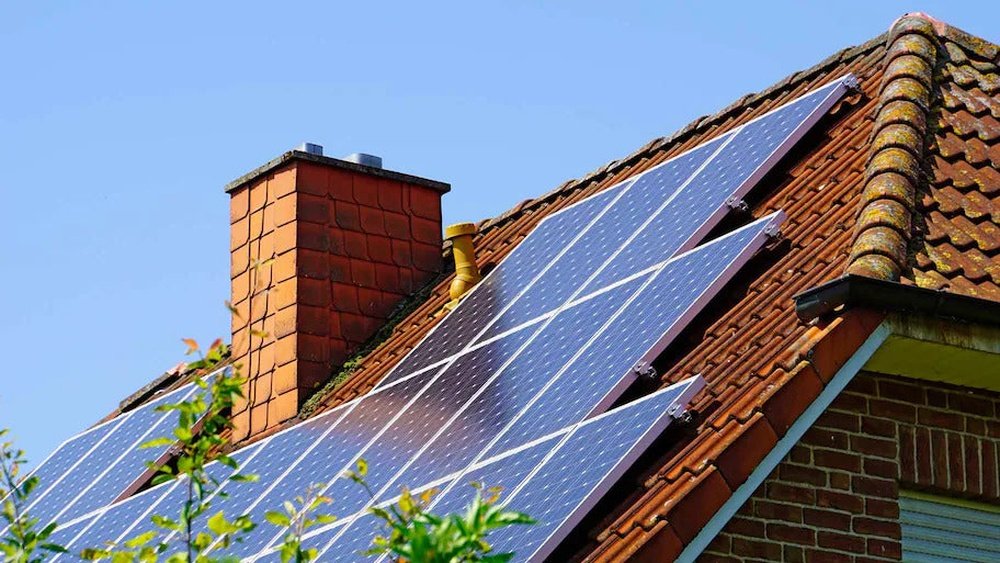
For most homeowners, the panel tilt angle isn’t a free choice — it’s constrained by the pitch of your existing roof. Understanding how your roof pitch translates to a tilt angle is essential for evaluating how close to optimal your installation will be.
Roof pitch to tilt angle conversion:
Roof pitch is commonly expressed as a rise-to-run ratio (e.g., 4:12 means 4 inches of rise for every 12 inches of horizontal run). Converting to degrees:
Tilt Angle = arctan(Rise ÷ Run)
Quick conversion table:
| Roof Pitch | Tilt Angle | Common in |
|---|---|---|
| 1:12 | 4.8° | Very low-slope commercial |
| 2:12 | 9.5° | Low-slope residential |
| 3:12 | 14° | Low to moderate residential |
| 4:12 | 18° | Common US residential |
| 5:12 | 22.6° | Most common US residential |
| 6:12 | 26.6° | Moderate steep residential |
| 7:12 | 30° | Steeper residential |
| 8:12 | 33.7° | Steep residential |
| 9:12 | 36.9° | Very steep |
| 10:12 | 40° | Near optimal for northern US |
| 12:12 | 45° | High-pitch/Cape Cod style |
What this means in practice:
For most US homeowners with a 4:12 to 6:12 roof pitch (18°–27°), the existing roof tilt is below optimal for northern states (which ideally want 35°–45°) but close to optimal for southern states (which ideally want 20°–30°). Standard roof-mounted solar on a typical American home loses roughly 3–8% annual energy compared to optimal tilt — a small but not trivial gap that tilt mounts can close.
Flat Roofs — What Tilt Angle to Use
Flat roofs (0°–5° pitch) are common in commercial buildings and are increasingly found in residential construction. Panels installed flat (0° tilt) produce approximately 20–25% less energy than optimally tilted panels — a significant loss that tilt mounting frames directly solve.
The minimum recommended tilt for flat roof installations is 10°. This serves two purposes:
- Energy production — Even 10° tilt captures meaningfully more energy than flat installation, particularly for diffuse light on cloudy days
- Self-cleaning — Rain can wash dust and debris off a tilted panel. At 0° tilt, dust accumulates and stays, causing soiling losses of 5–15% in dry or dusty climates. A 10° minimum tilt allows rainfall to clean the panels naturally
Recommended flat roof tilt angles:
| Goal | Recommended Tilt |
|---|---|
| Minimum acceptable | 10° |
| Good annual performance | Latitude ÷ 2 (compromise for space vs. output) |
| Optimal annual performance | Full latitude angle |
| Maximum winter production | Latitude + 15° |
Spacing consideration for flat roofs: Tilting panels on a flat roof requires leaving space between rows to prevent the front row from shading the row behind it. The required inter-row spacing increases with tilt angle. At optimal tilt, the spacing requirement can be 2–3× the panel length — meaning a flat roof with optimal tilt holds significantly fewer panels than the same roof with 10–15° tilt. Installers optimize this trade-off between tilt angle and panel density for each project.
Tilt Angle for Off-Grid and Ground-Mounted Systems
If you have the freedom to choose any tilt angle — a ground-mounted system, an adjustable rack, or an off-grid cabin installation — you have a significant advantage over fixed rooftop installations.
For year-round optimization: Set tilt to your latitude angle. This is the single adjustment that delivers the best average annual performance with no further adjustment needed.
For winter-priority optimization: If your off-grid system must be self-sufficient through winter with minimal generation, set tilt to latitude + 15°. This sacrifices some summer production in exchange for meaningfully better winter output — critical for maintaining battery charge and system independence during the low-sun months.
For twice-yearly manual adjustment: Adjust to the winter angle (latitude + 15°) on the September equinox and back to the summer angle (latitude − 15°) on the March equinox. This two-adjustment-per-year approach captures approximately 70% of the theoretical gain from continuous tracking with just two manual adjustments annually.
For automatic adjustment — solar trackers: Single-axis trackers (which adjust azimuth throughout the day, following the sun east to west) improve energy output by 20–30% compared to fixed-tilt panels. Dual-axis trackers (which also adjust tilt with the seasons) can improve output by 35–40%. The additional energy must be weighed against the significantly higher cost and maintenance requirements of tracking systems — typically worthwhile for large ground-mounted commercial systems but rarely cost-effective for small residential installations.
How Much Energy Do You Lose With Wrong Tilt?
Let’s put hard numbers on the energy penalty for suboptimal tilt. These figures assume a mid-latitude location (35°–45° N) with optimal south-facing orientation.
| Tilt Angle | Annual Output vs. Optimal | Energy Loss Per Year (7 kW system) |
|---|---|---|
| 0° (flat) | ~72% | ~2,800 kWh/year lost |
| 10° | ~85% | ~1,500 kWh/year lost |
| 15° | ~91% | ~900 kWh/year lost |
| 20° | ~95% | ~500 kWh/year lost |
| 25° | ~98% | ~200 kWh/year lost |
| 30° | ~99% | ~100 kWh/year lost |
| Optimal (lat°) | 100% | 0 |
| Optimal + 5° | ~99% | ~100 kWh/year lost |
| Optimal + 10° | ~97% | ~300 kWh/year lost |
| Optimal + 20° | ~92% | ~800 kWh/year lost |
| 90° (vertical) | ~55–65% | ~3,500–4,500 kWh/year lost |
The numbers make an important point: the penalty for being close to optimal is small, but the penalty for being far from optimal — particularly too flat — is very large. A flat roof installation at 0° loses nearly 30% of potential annual energy. Getting to even 15–20° recovers most of that loss.
The practical implication: if your roof doesn’t allow optimal tilt, it’s almost always worth installing tilt mounting frames to at least reach 15–20° — especially in northern locations where the sun angle is lower and tilt optimization matters more.
Best Online Tilt Angle Calculators
These are the best free tools for calculating your precise optimal tilt angle:
PVWatts Calculator (pvwatts.nrel.gov) — The gold standard for US locations. Enter your address and it returns optimal tilt angle, system production estimates, and monthly energy generation for your specific location. Used by professional installers nationwide.
Global Solar Atlas (globalsolaratlas.info) — World Bank backed, globally accurate. Enter any address worldwide for irradiance data and optimal tilt recommendations. Best for international locations.
Solar Math Lab Tilt Calculator (solarmathlab.com) — Simple interface, enter your latitude and instantly get annual, summer, and winter optimal tilt angles with clear explanations.
Footprint Hero Solar Panel Angle Calculator (footprinthero.com/solar-panel-angle-by-zip-code) — US-focused, zip code based, returns monthly optimal tilt angles in an easy-to-read format. Great for homeowners who want a quick, practical answer.
Shop Solar Kits Tilt Calculator (shopsolarkits.com/pages/solar-panel-tilt-angle-calculator) — Similar to Footprint Hero, US zip code based, returns seasonal and monthly tilt recommendations.
SunSolar Tilt Calculator (sunsolartilt.com) — Simple, global coverage, works by entering your city name or coordinates.
For the most accurate result for your specific address, PVWatts (US) or Global Solar Atlas (worldwide) are the two tools professional installers rely on. Any other tool that uses your latitude directly (rather than satellite irradiance data) is an approximation — useful and close, but less precise than the data-backed tools.
Frequently Asked Questions
What is the best tilt angle for solar panels?
The best annual tilt angle equals your location’s latitude in degrees. If you live at 35° N latitude, your optimal annual tilt is approximately 35°. This can be refined slightly to latitude minus 2.5° for marginally better average annual performance. For seasonal optimization, adjust to latitude minus 15° in summer and latitude plus 15° in winter.
Does tilt angle really make a significant difference?
Yes — significantly. Panels installed at 0° (flat) produce approximately 72% of the energy they would generate at optimal tilt in mid-latitude locations. Getting even to 15–20° tilt recovers most of this loss. The difference between 0° and optimal tilt on a 7kW system amounts to approximately 2,500–3,000 kWh per year — enough to power a full-size refrigerator for more than six years.
What tilt angle should I use if I can’t adjust my roof pitch?
Install panels flush with your existing roof and accept the suboptimal tilt — it’s still far better than not having solar at all. Most residential roofs have 4:12 to 6:12 pitch (18°–27°), which is close to optimal for southern US locations and somewhat below optimal for northern states. The energy loss from a typical residential roof pitch is roughly 3–8% compared to perfectly optimal tilt — meaningful but not disqualifying.
Should I use the same tilt angle year-round?
For rooftop systems — yes, because you can’t easily adjust them anyway. For ground-mounted systems where you have the option, adjusting twice a year (to winter angle in September, summer angle in March) improves annual production by approximately 5–10%. For maximum optimization with minimal effort, twice-yearly adjustment hits the sweet spot between complexity and performance benefit.
What tilt angle for equatorial locations (near 0° latitude)?
Near the equator — Singapore, Indonesia, parts of Africa, Ecuador — the sun passes almost directly overhead throughout the year. The optimal tilt angle approaches 0°, and panels can essentially be mounted flat or at a minimal angle. However, a minimum 10° tilt is still recommended for self-cleaning by rainfall — preventing dust accumulation that would reduce output in the absence of regular manual cleaning.
How does tilt angle affect snow shedding in cold climates?
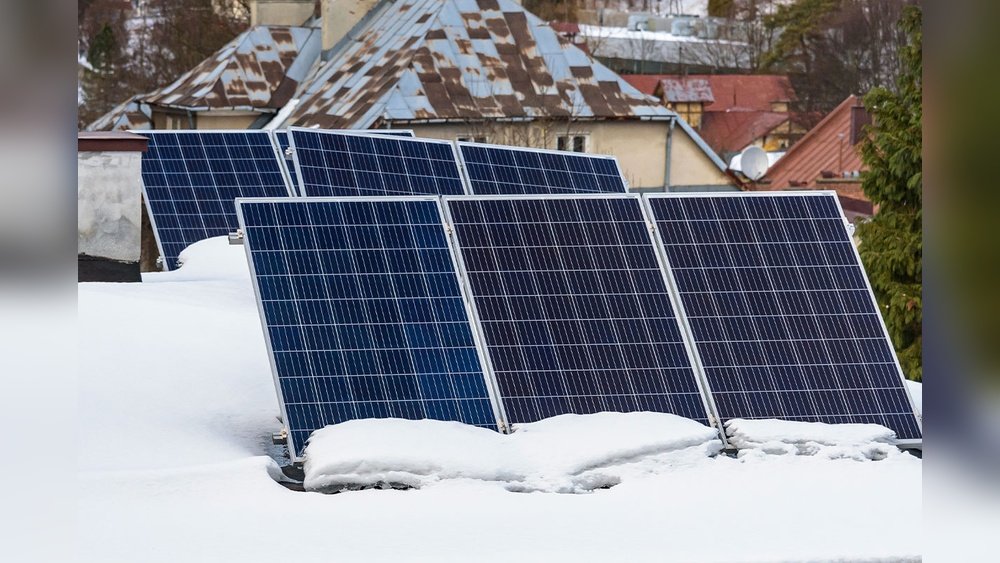
In snowy climates, steeper tilt angles (45°+) shed snow more effectively than shallow angles — snow slides off before significantly blocking sunlight. A 30°+ tilt angle sheds most snow naturally in a day or two. Panels at 15–20° can retain snow for extended periods, losing days of winter generation. In heavy snow states like Michigan, Minnesota, Vermont, and upstate New York, erring toward a steeper tilt angle (toward latitude + 10°) improves winter performance both through better sun angle capture and faster snow shedding.
Do solar trackers eliminate the need to calculate tilt angle?
Single-axis trackers automatically follow the sun’s east-to-west movement throughout the day — improving output by 20–30% — but don’t continuously optimize the elevation angle. Dual-axis trackers follow both azimuth and elevation, continuously optimizing both direction and tilt simultaneously — achieving 35–40% more energy than fixed panels. For ground-mounted commercial systems with high land availability, trackers are often cost-effective. For residential rooftop installations, fixed optimal tilt remains the standard approach.