
You’ve invested in solar panels. Now comes the question most people don’t think about until they’re already buying: where does the energy actually go when the sun isn’t shining?
The answer is a solar battery. It stores the electricity your panels generate during the day and releases it at night, during cloudy weather, or during a power outage. Without storage, any solar energy your panels produce that you don’t use immediately either goes back to the grid — often at a low feed-in tariff — or is simply wasted.
But solar batteries are not all the same. There are several distinct battery chemistries in use today, each with dramatically different performance, lifespan, cost, and safety profiles. Choosing the wrong type for your situation means spending more money than necessary or getting a system that doesn’t meet your actual needs.
This guide covers every type of battery used in solar systems — from the current gold standard (lithium iron phosphate) to the budget-friendly workhorses (lead-acid) to the cutting-edge technology used in utility-scale solar farms (flow batteries) — with everything you need to make the right choice.
How Solar Batteries Work
Before comparing battery types, it helps to understand what a solar battery is actually doing inside a system.
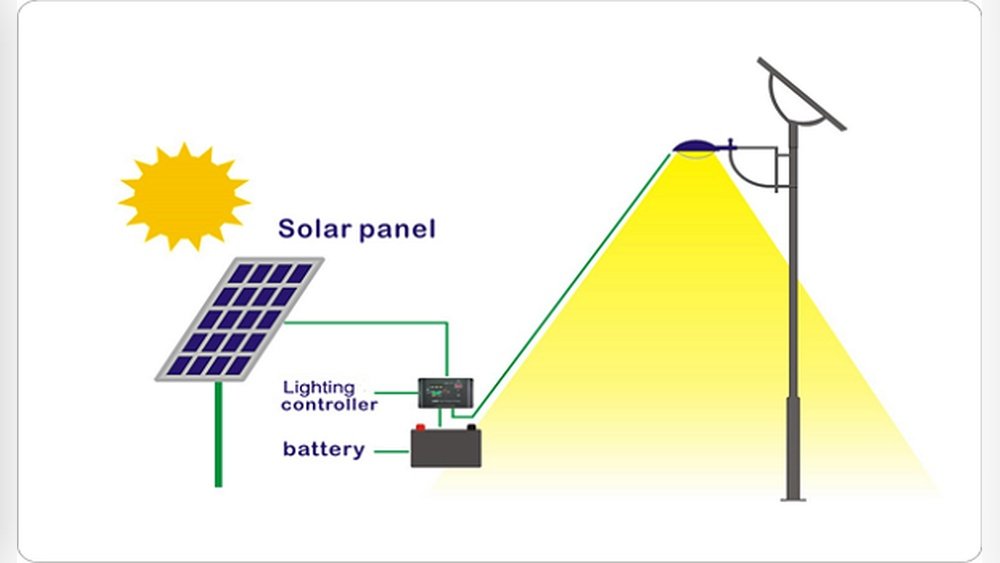
Your solar panels generate direct current (DC) electricity from sunlight. That electricity flows through a charge controller, which regulates the voltage and current going into the battery to prevent overcharging and damage. The battery stores the energy chemically — inside the battery’s cells, electrical energy is converted into chemical energy and held there until needed.
When you need power — at night, during a cloudy stretch, or when the grid goes down — the battery discharges. The stored chemical energy converts back into electrical energy and flows out of the battery through an inverter, which converts DC electricity into the AC electricity your home appliances use.
The efficiency of this charging and discharging cycle is called round-trip efficiency — the percentage of energy you put into the battery that you actually get back out. A battery with 90% round-trip efficiency returns 90 kWh for every 100 kWh stored. The remaining 10% is lost as heat during the chemical conversion process. Higher round-trip efficiency means more of your solar energy reaches your appliances rather than being wasted.
Two other critical terms to understand before comparing battery types:
Depth of Discharge (DoD) is the percentage of the battery’s total capacity you can use before it needs recharging. A battery with a 100 kWh capacity and an 80% DoD gives you 80 kWh of usable storage. Lead-acid batteries typically recommend only 50% DoD to preserve their lifespan, meaning you only access half their rated capacity. Lithium batteries can safely discharge to 80–95% DoD, making far more of their capacity genuinely usable.
Cycle life is how many complete charge-discharge cycles a battery can perform before its capacity degrades to 80% of its original rating. A battery rated for 3,000 cycles used daily lasts about 8 years before needing replacement.
Main Types of Solar Batteries
There are four main categories of batteries used in solar energy storage today, ranging from the oldest and cheapest to the newest and most advanced:
- Lithium-ion batteries (LFP and NMC) — the current market standard for residential and commercial solar
- Lead-acid batteries (flooded, sealed, AGM, gel) — the legacy technology, still relevant for budget off-grid systems
- Flow batteries — advanced technology for utility-scale and large commercial solar storage
- Sodium-sulfur batteries — high-temperature chemistry used exclusively for grid-scale storage
Lithium-ion batteries now account for over 90% of new residential solar battery installations worldwide, a dominance that has grown steadily over the past decade as prices have fallen and performance has improved.
Lithium-Ion Batteries (LFP & NMC)
Lithium-ion is the dominant battery technology for solar storage in 2026 — found in everything from the Tesla Powerwall to portable power stations to commercial grid storage systems. Within the lithium-ion family, two chemistries matter most for solar applications.
LFP (Lithium Iron Phosphate) — The Gold Standard
LFP — also written as LiFePO4 — is rapidly becoming the preferred chemistry for stationary solar storage, and for excellent reasons.
The chemistry uses iron and phosphate in the cathode, which gives it an unusually stable molecular structure. This stability has two major practical consequences. First, LFP batteries are highly resistant to thermal runaway — the dangerous condition where a battery overheats and potentially catches fire. LFP is far safer than other lithium chemistries in hot weather and heavy use conditions, which is exactly what solar batteries experience year-round. Second, the stable structure means the battery degrades more slowly over charge cycles — LFP batteries typically deliver 3,000–6,000 cycles before dropping to 80% capacity, with high-end systems rated for over 6,000 cycles lasting 10–15 years of daily use.
LFP batteries operate at approximately 3.2 volts per cell. Multiple cells are combined in series to create 12V, 24V, or 48V battery banks for different system sizes — 48V systems being the most common for modern residential solar storage.
Depth of discharge is a key advantage. LFP batteries can be safely discharged to 80–95% of their capacity, compared to 50% for lead-acid. This means a 10 kWh LFP battery delivers 8–9.5 kWh of usable energy. An equivalent lead-acid battery only delivers 5 kWh usably despite the same rated capacity.
Round-trip efficiency runs 90–95%, meaning very little of your stored solar energy is lost as heat during charging and discharging.
The main limitations of LFP are its slightly lower energy density compared to NMC (meaning a larger, heavier battery for the same storage capacity) and its performance in very cold temperatures — below -10°C, charging rate should be reduced to prevent cell damage, and capacity temporarily decreases in freezing conditions.
Best for: Residential solar homes, commercial solar storage, off-grid systems, anyone wanting a safe, long-lasting, low-maintenance battery.
NMC (Nickel Manganese Cobalt)
NMC is the other major lithium chemistry used in solar batteries. It offers higher energy density than LFP — storing more energy in a smaller, lighter package — which is why it’s also dominant in electric vehicles where weight and space matter enormously.
For stationary solar storage, however, NMC’s advantages are less compelling. It operates at higher temperatures and is more susceptible to thermal runaway than LFP. Its cycle life is generally shorter — typically 1,000–2,000 cycles compared to LFP’s 3,000–6,000. And it contains cobalt, which raises both cost and ethical supply chain concerns.
Earlier generations of the Tesla Powerwall used NMC chemistry. The industry trend in 2026 is strongly toward LFP for stationary storage, with NMC increasingly reserved for applications where energy density genuinely justifies the trade-offs.
Best for: Applications where compact size and light weight are the primary priorities.
Lead-Acid Batteries
Lead-acid is the oldest rechargeable battery technology in widespread use — invented in 1859 and still relevant today for specific solar applications. They work by immersing lead plates in a sulfuric acid electrolyte solution. When charging, electrical energy converts lead sulfate back into lead and lead dioxide. When discharging, the reverse reaction releases electrical energy.
Lead-acid batteries are the cheapest solar storage option by a significant margin — a 10 kWh lead-acid system can cost less than half of an equivalent lithium system. This makes them the only realistic option for extremely budget-constrained off-grid setups.
The trade-offs are significant. Cycle life is 300–1,000 cycles — meaning a daily-use system may need replacement in 2–3 years. Usable depth of discharge is only 50%, effectively halving the usable capacity relative to the rated figure. Round-trip efficiency runs 70–85%, lower than lithium. They require regular maintenance in their flooded versions — checking electrolyte levels, topping up with distilled water, cleaning terminals. They’re heavy — roughly 3–5x heavier than an equivalent lithium system. And they perform poorly in hot climates, which unfortunately is exactly where solar generation is highest.
The flooded lead-acid battery is the traditional version with accessible liquid electrolyte. Sealed lead-acid (SLA) batteries immobilize the electrolyte and require no maintenance, making them significantly more practical for solar use.
Best for: Very small off-grid cabins, agricultural remote power, budget DIY solar systems used infrequently, and applications where upfront cost completely outweighs long-term performance.
Gel Batteries
Gel batteries are a variant of sealed lead-acid where the liquid electrolyte is thickened into a gel using silica. The gel immobilizes the electrolyte completely, eliminating any risk of spills and making the battery genuinely maintenance-free.
Gel batteries tolerate deep discharge better than standard flooded lead-acid — usable DoD extends to around 60–75%. They handle heat better than flooded lead-acid and perform well in the temperature ranges typical of solar installations in warm climates.
They charge more slowly than flooded lead-acid and are sensitive to overcharging — a gel battery charged with an incompatible charger or charge controller degrades rapidly. Ensuring your charge controller has a gel-specific charging profile is essential.
Gel batteries are well suited for off-grid solar systems in locations where maintenance access is difficult or infrequent — remote cabins, agricultural pumping stations, telecommunications infrastructure. They cost more than flooded lead-acid but significantly less than lithium.
Best for: Off-grid solar in remote locations, agricultural applications, harsh environments where maintenance is difficult.
AGM Batteries
AGM stands for Absorbed Glass Mat. In AGM batteries, the electrolyte is absorbed into a fiberglass mat separator between the lead plates rather than existing as free liquid or gel. This construction makes AGM batteries completely sealed, spill-proof, and installable in any orientation.
AGM batteries offer better performance than standard flooded lead-acid across almost every metric — faster charging, better cycle life (typically 500–1,200 cycles), lower internal resistance, and better cold-weather performance. They handle moderate discharge depths reasonably well.
They’re commonly used in off-grid residential solar systems, marine solar installations, and RV solar setups where the battery may be oriented in different positions. They cost more than flooded lead-acid but less than lithium, sitting in a practical middle ground.
The main limitation compared to lithium remains cycle life and usable capacity — even the best AGM batteries deliver fewer cycles and less usable energy per kilogram than LFP. For systems used daily, the total energy delivered over the battery’s lifetime is lower than lithium despite a lower upfront price.
Best for: Off-grid solar homes on a moderate budget, marine and RV solar, systems requiring good cold-weather performance without the lithium price premium.
Flow Batteries
Flow batteries represent a fundamentally different approach to energy storage. Instead of storing energy in solid electrode materials, they store it in liquid electrolytes held in external tanks. During charging and discharging, the electrolyte solutions flow through a central reaction cell — which is where the energy conversion happens — and back into the storage tanks.
The most commercially advanced flow battery technology for solar storage is the Vanadium Redox Battery (VRB), which uses vanadium ions dissolved in sulfuric acid as the electrolyte in both tanks.
Flow batteries have extraordinary cycle life — 10,000–15,000 cycles is typical, compared to 3,000–6,000 for LFP. At daily cycling, a flow battery can last 25–40 years before significant degradation. They can be discharged to 100% DoD without damage. Capacity is increased simply by adding more electrolyte — the reaction cell remains the same size, and the storage tanks scale independently. This makes them highly flexible for large-scale applications.
The limitations are equally significant for most users. Flow batteries are large, expensive, and complex. The minimum practical system size is several hundred kilowatt-hours — far larger than any residential need. The energy density is low — 20–35 Wh/kg compared to 150–200 Wh/kg for LFP — meaning they occupy enormous physical space per unit of storage. They require pumps, plumbing, and more maintenance than sealed battery systems.
Flow batteries are genuinely transformative technology for utility-scale solar farms, grid stabilization, and large industrial facilities. For homes and small commercial buildings, they remain impractical in 2026.
Best for: Utility-scale solar farms, grid storage, large industrial facilities, community microgrids.
Sodium-Sulfur Batteries
Sodium-sulfur (NaS) batteries are high-temperature electrochemical cells that operate at approximately 300–350°C. At these temperatures, both sodium (the negative electrode) and sulfur (the positive electrode) are molten liquids. The reaction between them through a solid ceramic electrolyte stores and releases energy with high efficiency.
NaS batteries offer excellent energy density and round-trip efficiency of around 90%. They have good cycle life and can handle deep discharge. The high operating temperature requirement means they’re self-heating — they maintain their own operating temperature through their charge-discharge reactions — but this also means they must operate continuously or be reheated from cold, which is impractical for intermittent home use.
They are exclusively used for large-scale commercial and utility solar storage — grid stabilization, peak shaving for industrial facilities, and renewable energy integration at the megawatt-hour scale. Japan has deployed NaS battery systems extensively for grid-scale renewable storage.
Best for: Grid-scale utility solar storage, large industrial facilities, megawatt-scale renewable energy integration.
Head-to-Head Comparison
| Specification | LFP Lithium | NMC Lithium | Lead-Acid | AGM | Gel | Flow (Vanadium) |
|---|---|---|---|---|---|---|
| Cycle Life | 3,000–6,000 | 1,000–2,000 | 300–1,000 | 500–1,200 | 500–1,200 | 10,000–15,000 |
| Round-Trip Efficiency | 90–95% | 90–95% | 70–85% | 80–85% | 75–85% | 70–85% |
| Depth of Discharge | 80–95% | 80–95% | 50% | 50–60% | 60–75% | 100% |
| Energy Density (Wh/kg) | 150–200 | 200–300 | 30–50 | 30–50 | 30–50 | 20–35 |
| Lifespan | 10–15 years | 7–10 years | 2–5 years | 4–7 years | 4–8 years | 20–30 years |
| Maintenance | None | None | High | None | None | Low–Moderate |
| Safety | Excellent | Good | Good | Good | Good | Excellent |
| Upfront Cost | Moderate–High | Moderate–High | Low | Low–Moderate | Moderate | Very High |
| Best Scale | Home/Commercial | Home/EV | Small off-grid | Off-grid/RV | Off-grid | Utility/Industrial |
Which Battery Is Right for You?
The right battery depends entirely on your system type, budget, and priorities. Here’s a practical framework.
Choose LFP lithium if you’re installing a residential or commercial solar system, want a battery that lasts 10+ years with minimal attention, value safety, and plan to use the system daily. This covers the vast majority of modern solar battery buyers. LFP’s combination of safety, longevity, efficiency, and falling prices makes it the clear best-all-around choice in 2026.
Choose NMC lithium if compact size and light weight are your primary requirements — such as a van or RV solar installation where space is genuinely at a premium. Be aware that cycle life is shorter than LFP.
Choose AGM or gel lead-acid if you have a strict upfront budget, your system will be used infrequently (a seasonal cabin or emergency backup used a few times per year), or you’re building a small DIY off-grid system and cost is the only priority. For daily-use systems, the shorter lifespan of lead-acid means the total cost over 10 years often exceeds lithium despite the lower upfront price.
Choose flooded lead-acid only if the system is extremely small, budget is the absolute constraint, and you’re comfortable with regular maintenance checks. In most other scenarios, sealed AGM or gel is more practical.
Choose flow batteries if you’re managing a commercial or industrial facility with large energy storage needs, require guaranteed 20+ year operational life, and the system scale justifies the complexity and cost.
Top Solar Battery Brands in 2026
These brands consistently rank at the top for quality, reliability, and after-sales support.
Tesla Powerwall 3 remains the most recognized residential solar battery globally. The Powerwall 3 uses LFP chemistry, integrates an inverter into the unit, and connects seamlessly with Tesla solar panels. Available in 13.5 kWh capacity per unit with stackable design for greater storage.
Enphase IQ Battery 5P is a modular AC-coupled battery system that pairs perfectly with Enphase solar microinverters. Its all-AC design simplifies installation and makes it easy to expand by adding modules. Uses LFP chemistry.
BYD Battery-Box Premium is one of the most popular LFP solar batteries globally, particularly in Europe and Asia-Pacific markets. BYD is the world’s largest LFP battery manufacturer, and their solar storage products benefit from the same manufacturing expertise driving their EV batteries.
SolarEdge Home Battery integrates tightly with SolarEdge solar inverters and uses LFP chemistry. Popular for residential installations using the SolarEdge ecosystem.
Sungrow SBR series offers competitive LFP performance at strong value — particularly popular in Asia-Pacific and increasingly in European markets. High cycle life rating and modular design.
CATL FREENER represents the world’s largest battery manufacturer entering the residential solar storage market directly — high-quality LFP cells with strong performance metrics and competitive pricing.
Crown Battery and Trojan Battery remain the top choices for lead-acid solar batteries in the off-grid market — used in agricultural, remote, and budget solar installations where lithium isn’t economically justified.
Key Terms Explained
kWh (Kilowatt-hour) — the unit of energy storage capacity. A 10 kWh battery stores enough energy to run a 1,000W appliance for 10 hours, or a 100W appliance for 100 hours.
Cycle — one complete charge followed by one complete discharge. A battery rated for 3,000 cycles will complete 3,000 of these before degrading to 80% of its original capacity.
DoD (Depth of Discharge) — the percentage of total battery capacity that can be safely used. A 10 kWh battery with 80% DoD provides 8 kWh of usable energy.
C-rate — how fast a battery can charge or discharge relative to its capacity. A 1C rate means the battery fully charges or discharges in one hour. A 0.5C rate means it takes two hours.
BMS (Battery Management System) — the electronic brain inside a modern lithium battery that monitors voltage, temperature, and current in each cell, balancing them to prevent overcharge, over-discharge, and overheating. A quality BMS is essential for safe lithium battery operation.
State of Charge (SoC) — how full the battery currently is, expressed as a percentage. 100% SoC is fully charged. 0% is fully discharged (though most systems stop discharge before reaching 0% to protect the battery).
Thermal Runaway — a dangerous condition where a battery cell overheats, causing a chemical reaction that generates more heat, which causes more reactions in a self-reinforcing cycle that can lead to fire or explosion. LFP chemistry is highly resistant to thermal runaway, which is a key safety advantage over NMC.
Frequently Asked Questions
What is the best type of battery for residential solar?
LFP (Lithium Iron Phosphate) is the best all-around choice for residential solar in 2026. It offers 3,000–6,000 cycles of lifespan, 90–95% round-trip efficiency, 80–95% usable depth of discharge, zero maintenance, and excellent safety. Lithium-ion batteries now account for over 90% of new residential solar battery installations worldwide, with LFP rapidly becoming the dominant chemistry within that category.
How long do solar batteries last?
LFP lithium batteries last 10–15 years of daily use before capacity drops to 80% of the original rating. Lead-acid batteries last 2–5 years under daily solar cycling. AGM and gel batteries last 4–8 years. Flow batteries last 20–30 years. The right lifespan for your situation depends on how frequently the battery cycles and your long-term budget planning.
Can I use a car battery for solar storage?
Standard automotive batteries are starter batteries — designed to deliver a very large burst of current for a few seconds to start an engine, then recharge immediately from the alternator. They are not designed for the deep, repeated discharge cycles of solar storage and will fail very quickly — typically within months — if used this way. Always use deep-cycle batteries designed for solar or renewable energy storage applications.
What size battery do I need for a solar system?
Multiply your average daily electricity consumption (in kWh) by the number of days of autonomy you want (how many days you want to run without solar input). Divide by the battery’s DoD. The result is your minimum capacity requirement. For example: 10 kWh/day × 1.5 days ÷ 0.8 DoD = 18.75 kWh minimum battery capacity. Most residential solar systems install 10–20 kWh of lithium storage for a comfortable daily-use and short backup capability.
What is the difference between on-grid and off-grid solar battery use?
An on-grid solar system connects to the utility grid and uses a battery primarily to store excess solar energy for self-consumption and provide backup during outages. When the battery is full and solar is still producing, excess energy is exported to the grid. An off-grid system has no grid connection — the battery must store enough energy to supply the entire household through nights and cloudy periods independently. Off-grid systems require significantly larger battery banks and more careful sizing.
Do solar batteries work during a power outage?
Yes — but only if the system is specifically configured for backup operation. A standard grid-tied solar system without a battery will shut down during an outage for safety reasons, even if the sun is shining. A battery system with an automatic transfer switch configured for backup mode will continue supplying power during an outage. Always confirm that backup functionality is enabled when purchasing a solar battery system.
How do temperature extremes affect solar battery performance?
All battery chemistries are affected by temperature, but to different degrees. LFP lithium performs well from -20°C to 60°C, though charging in temperatures below -10°C should be done at a reduced rate. Lead-acid batteries lose capacity significantly in cold weather and degrade faster in heat. For installations in climates with extreme heat or cold, proper thermal management of the battery enclosure — shade in summer, insulation in winter — extends battery life meaningfully.
What is the most affordable solar battery option?
Flooded lead-acid batteries have the lowest upfront cost — a 10 kWh system can be 50–60% cheaper than an equivalent LFP lithium system. However, when you calculate total cost over 10 years — including replacement costs (lead-acid may need replacing 2–3 times in the lifespan of one lithium system), the cost of the energy lost to lower efficiency, and maintenance expenses — LFP often proves less expensive over the system’s full life. For systems used daily, LFP is frequently the more economical long-term choice despite higher initial purchase price.