
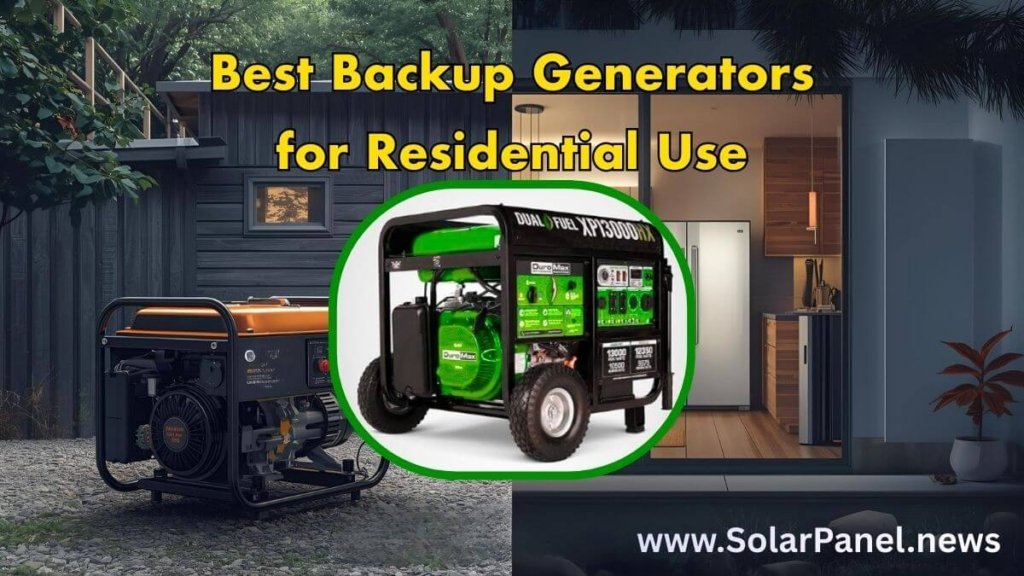
When the power goes out, having one of the top backup generators for residential use can protect your home, your appliances, and your peace of mind. Whether you want a compact solar generator for short outages or a heavy-duty fuel model for whole-home backup, this guide helps you choose the best fit.

Below, I break down 10 highly rated residential backup generators, explain their best use cases, and include pros/cons to make your buying decision easier.
10 Best Residential Backup Generators
| Generator Name | Capacity | Output | Power Type | Best For |
| EGO POWER+ PST3040 | Battery powered | 3kW | Inverter | Home + outdoor versatility |
| BLUETTI AC50B | 448Wh | 700W | Solar + battery | Small devices, travel, outages |
| Jackery Explorer 1000 v2 | 1070Wh | 1.5kW | Solar + battery | Medium home essentials |
| EcoFlow RIVER 3 | 245Wh | 300–600W | Solar + battery | Light emergency use |
| Anker SOLIX C1000 Gen 2 | 1024Wh | 2kW | Solar + battery | High-demand devices |
| Portable Power Station 700W | 577Wh | 700–1000W | Solar + battery | CPAP + basic home needs |
| Erayak 4500PD Tri-Fuel | Large | 4.5kW | Gas/Propane/Natural gas | Whole-home/long outages |
| Westinghouse WGen7500DFc | 7.5kW | 9500 Peak | Dual Fuel | Home backup + transfer switch |
| DuroMax XP10000E | 8kW–10kW | Gas | Whole home | Long-term outages |
| OUKITEL P5000 PRO | 5120Wh | 3.6kW | Solar + battery | Whole-home battery backup |
Top 10 Backup Generators for Residential
Portable Power Stations (Solar Generator)
Portable power stations (also called solar generators when paired with solar panels) are an increasingly popular choice for home backup. They run on rechargeable lithium batteries, offer clean power safe for sensitive electronics, and can be used indoors since they produce zero emissions. They are best for powering essential circuits and small to medium appliance loads for shorter outages.
1. Anker SOLIX C1000 Gen 2 Power Station

Anker’s SOLIX C1000 Gen 2 is a standout performer, offering 1024Wh capacity and a massive 2kW output (with SurgePad technology peaking at 3kW). It’s built on a durable LiFePO4 battery platform for longevity and can charge fully in an incredible 49 minutes, making it one of the fastest on the market. It’s ideal for home essentials, medical devices, and power tools, and comes with a water-resistant bag for easy transport or garage storage.
Pros: Ultra-fast 49-minute recharge, 3,000W peak output, long-lasting LiFePO4 battery, 2,000W continuous power.
Cons: Higher price point than lower-capacity units, accessory water-resistant bag is not a full hard shell.
2. Jackery Explorer 1000 v2 Portable Power Station For Residential Small Home Backup

The Jackery Explorer 1000 v2 is an evolution of one of the most popular portable power stations. It features a 1070Wh LiFePO4 battery, 1.5kW AC output, and a quick 1-hour wall charge. This v2 model upgrades the battery chemistry for a longer lifespan and better safety profile, making it a reliable workhorse for both indoor emergencies and off-grid adventures.
Pros: Robust 1.5kW output, 1-hour fast charging, high-durability LiFePO4 battery, pure sine wave inverter.
Cons: Output capacity may be insufficient for high-draw appliances like large A/C units.
3. OUKITEL P5000 PRO Portable Power Station

With a massive 5120Wh battery and a 3.6kW output, the OUKITEL P5000 PRO is one of the most capable residential battery generators. It features app control, UPS function, and supports solar input, perfect for full-home battery backup without fuel.
Pros: Huge 5120Wh capacity and 3600W output can run large appliances, LiFePO4 battery for 3500+ cycles, seamless App control.
Cons: Very heavy and large, making it less “portable” than smaller models; high investment cost.
4. ECOFLOW Portable Power Station RIVER 3 Version Power Generator

The EcoFlow RIVER 3 is built for ultimate portability and rapid deployment. It features a 245Wh capacity and 300W output (boostable to 600W with X-Boost), making it ideal for small essentials. Its crucial feature is the sub-20ms Uninterruptible Power Supply (UPS) switchover, which is fast enough to protect sensitive equipment like desktop computers and CPAP machines from power drops.
Pros:
- Ultra-quick UPS feature
- Compact and lightweight
- Super-fast charging
Cons:
- Small capacity
- Not intended for whole-home use
5. EGO POWER+ Portable Power Generator For Residential Home

The EGO POWER+ leverages EGO’s 56V ARC Lithium battery ecosystem. This is a powerful 3kW inverter generator, but note that the core batteries and charger are sold separately. It offers a huge advantage if you already own EGO tools, as you can use the same batteries. Its high output is fantastic for construction sites or running heavy-duty corded tools, and it delivers clean, quiet sine wave power.
Pros: High 3000W pure sine wave inverter output, seamlessly integrates with EGO’s tool battery ecosystem, quiet operation.
Cons: Batteries and charger must be purchased separately, significantly increasing the total cost.
6. BLUETTI: Top Backup Solar Generator For Residential Use

The BLUETTI AC50B is a lightweight solar generator that delivers 448Wh of power, that enough for essentials like phones, routers, CPAP machines, laptops, and lighting. The included 100W panel (ships separately) makes it a great portable solar solution for both home outages and weekend travel.
Pros:
- Compact & lightweight
- Long-lasting LiFePO4 battery
- Solar panel included
- Quiet, eco-friendly power
Cons:
- Not for high-watt appliances
- Smaller capacity for full home use
7. Portable Power Station 700W (Best Backup Generator For Small Home)

This 700W solar generator offers dependable off-grid power for CPAP users, small appliances, and home emergency kits. With 577Wh capacity and a pure-sine inverter, it’s a budget-friendly backup choice.
Pros:
- Affordable and reliable
- Supports CPAP machines
- Pure sine wave output
- Lightweight design
Cons:
- Not suitable for high-watt devices
- Slower charging speeds
Traditional Fuel Generators: For High Power and Long Run Time
Fuel-powered portable generators are the workhorse of home backup. They provide substantially higher wattage and can run for long periods by simply refueling. They are ideal for powering many circuits, including high-draw appliances like central air, well pumps, and electric water heaters. However, they must always be used outdoors due to carbon monoxide emissions.
8. DuroMax 10kW Gas Powered Portable Generator

The DuroMax XP10000E is designed for homeowners who need serious power. With 10,000 peak watts, electric start, and rugged engineering, it can keep nearly your entire home powered during extended outages.
Pros: Very high wattage (10kW peak), electric start, heavy-duty frame, transfer switch ready for whole-home application.
Cons: Loud, runs only on gasoline (shorter fuel shelf life than propane), high fuel consumption under heavy load.
9. Westinghouse Dual Fuel Generator For Residential Backup

The Westinghouse WGen7500DFc offers the flexibility of dual fuel (gasoline or propane) with 9,500 peak watts and 7,500 running watts (less on propane). Dual-fuel capability is a massive advantage. Propane can be stored indefinitely, is often cheaper, and is easier to get during a gas shortage. The electric start and built-in CO sensor (Carbon Monoxide) enhance safety and ease of use.
Pros:
- Transfer switch ready
- High wattage for home coverage
- Dual fuel flexibility
- Electric start + CO sensor
Cons:
- Requires routine maintenance
- Louder than inverter models
10. Erayak Tri-Fuel Dual Generator Bundle

The Erayak 4500PD is notable for its tri-fuel versatility, running on gasoline, propane, or natural gas. This 4500 kilowatt generator offers solid power for essentials and features an inverter, meaning it produces cleaner power than a conventional open-frame generator. The inclusion of a 50A Parallel Cord Kit is a huge bonus, allowing you to connect a second unit for double the power when your needs grow.
Pros: Tri-fuel capability (Gas, Propane, Natural Gas), clean inverter technology, comes with a parallel kit to double power output.
Cons: 4.5kW running power is mid-range, and requires a second unit for higher-capacity whole-home needs.
Buying Guide: Choosing the Right Residential Generator
Selecting the best backup system for your home comes down to two key questions: How much power do you need? and How long will you need it for?
1. Calculate Your Wattage Needs
The most critical mistake I see people make is buying a generator that’s too small. You need to account for both running watts (what the device uses continuously) and starting watts (the brief surge required to turn on motor-driven devices like refrigerators, pumps, or A/C units).
- Minimal Essentials (Lights, Wi-Fi, Phone, CPAP): ~500W–1,500W running. A smaller Portable Power Station is perfect here.
- Essentials + Fridge + Microwave/Small Tools: ~2,500W–5,000W running (with appropriate surge capacity). A mid-range Portable Power Station or a small/mid-size Fuel Generator is a good fit.
- Whole House (A/C, Well Pump, Fridge, Lights, Water Heater): ~7,500W–12,000W+ running. You will need a large Fuel Generator or a powerful, expandable Portable Power Station System.
Pro Tip: Always calculate your total running watts and then add the single highest starting wattage of the appliances you plan to run simultaneously. This ensures your generator can handle the power spike without tripping.
2. Battery vs. Fuel: Which is Right for You?
| Choose a Portable Power Station if you… | Choose a Fuel Generator if you… |
| Primarily need to power essential electronics (Wi-Fi, medical devices, lights). | Need to power major appliances (Central A/C, electric water heater, well pump).13 |
| Value quiet operation and clean, indoor use. | Expect long-duration outages (multiple days/weeks) and have a large fuel supply. |
| Want very low maintenance and quick setup (plug-and-play). | Prioritize maximum power output and continuous run time. |
| Need clean, pure sine wave power for sensitive computers. | Have a setup for safe, outdoor use and are comfortable with fueling/maintenance. |
Related Post: Best Rated Generators for Residential
By carefully evaluating your home’s needs against the strengths of these top backup generators for residential use, you can confidently prepare for the next power outage.