
If you’re shopping for the best solar phone charger, you’re probably trying to solve a specific problem: keeping a phone alive when outlets aren’t available. Not all solar chargers do that equally well. Some work best as direct sunlight chargers, others are really power banks that slowly refill with solar help.
The difference matters. Below is a clear, no-frills breakdown of five popular options, focusing on real-world charging usefulness, portability, and limitations that often get glossed over. This is about choosing what fits your situation, not chasing specs that won’t help you outdoors.
Best Portable Solar Phone Charger for Hiking
| Phone Charger | Type | Max Output | Ports | Best Use Case | Key Limitation |
| Ecosonique 30W Foldable Solar Charger | Solar panel | 30W | USB-C, USB-A | Direct phone charging outdoors | No internal battery |
| ELECOM NESTOUT 28W Solar Panel | Solar panel | 28W | Dual USB-A | Rugged camping setups | Slower in weak sunlight |
| 42800mAh Solar Charger Power Bank | Power bank | 5V/3.1A | USB-A | Emergency backup | Solar charging is slow |
| 90000mAh Wireless Solar Power Bank | Power bank | 35W | 7 ports | Multi-device emergencies | Very bulky |
| GOODaaa 45800mAh Solar Power Bank | Power bank | 15W | USB-C, USB-A | Travel and preparedness | Heavy for daily carry |
Ecosonique 30W Portable Solar Charger
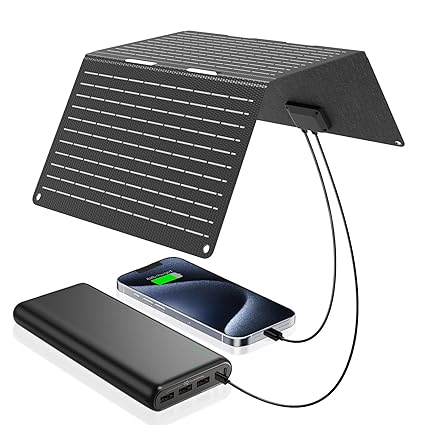
This is a solid choice if your goal is to charge a phone directly from sunlight while outdoors. The 30W panel output is strong enough to deliver steady power in good sun, especially when charging modern phones or topping off a power bank. In real use, it performs best when fully unfolded and angled correctly, which makes it well-suited for camping or backpacking stops.
The downside is simple: there’s no internal battery. If clouds roll in or the sun sets, charging stops. It’s not something you throw in a bag for emergencies without planning.
Verdict: Buy this if you want dependable daytime solar charging outdoors; skip it if you need stored power for nighttime or bad weather.
ELECOM NESTOUT Portable Solar Panel 28W
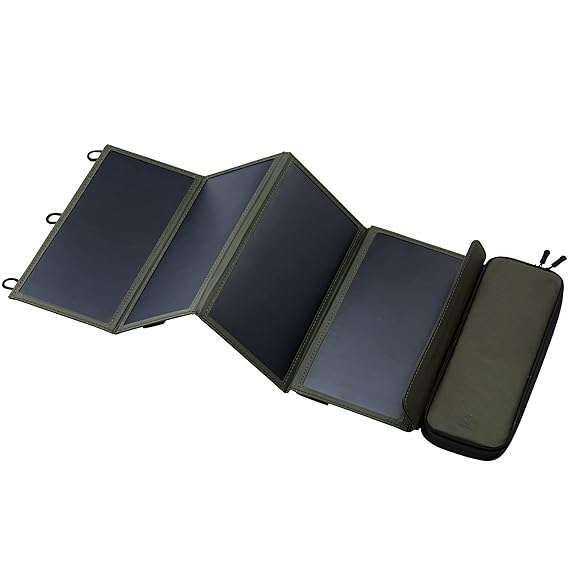
This charger is built with durability in mind. The ripstop fabric and water resistance make it a good match for rougher trips where gear takes a beating. Charging performance is consistent in strong sunlight, and the built-in stands help with positioning.
However, it doesn’t handle low-light conditions as well as higher-output panels. On overcast days, charging slows noticeably, and USB-A only limits fast charging for newer devices.
Verdict: A good fit for campers who prioritize durability over speed; not ideal if fast phone charging is the top priority.
Solar Charger Power Bank 42800mAh
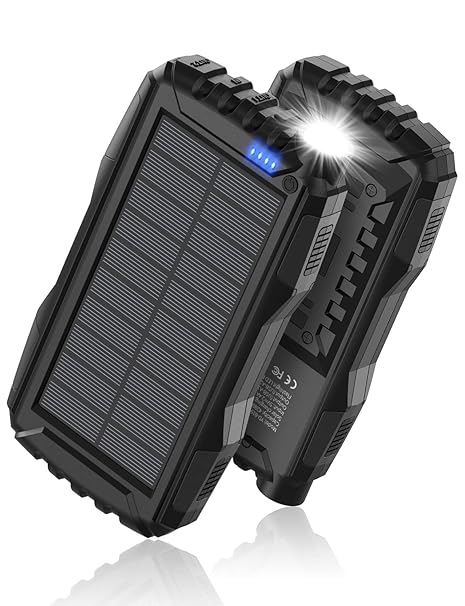
This product works best as a traditional power bank with solar as a backup feature. The large battery can charge a phone multiple times, which is useful during power outages or travel. The built-in flashlight adds some emergency value.
Solar recharging is slow. Leaving it in the sun helps extend battery life, but it’s not realistic to fully recharge it with sunlight alone.
My Verdict: Good for emergency kits and occasional outdoor use; not the best choice if you expect solar to be the main charging source.
90000mAh High Capacity Wireless Solar Power Bank
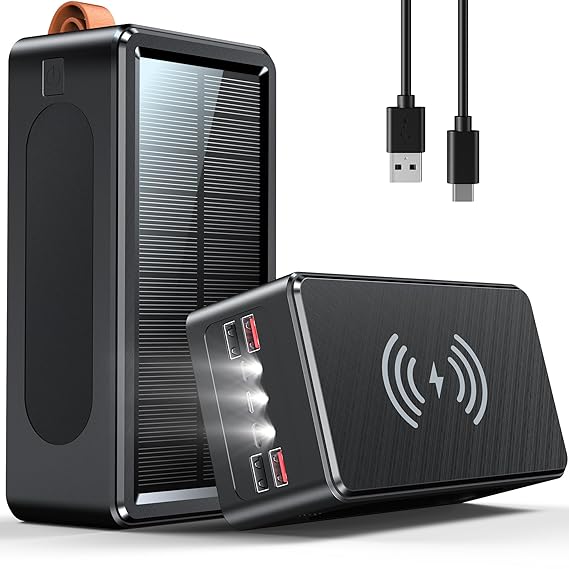
This is more of a mobile power station than a portable charger. It can handle phones, tablets, and multiple devices at once, including wireless charging. For emergencies or long off-grid situations, the capacity is hard to beat.
The trade-off is size and weight. Carrying this daily doesn’t make sense, and solar charging such a large battery takes patience.
Use Case: Best for base camps and emergency preparedness; skip it for lightweight travel or hiking.
GOODaaa 45800mAh Solar Power Bank

This option focuses on convenience. Built-in cables and wireless charging reduce clutter, making it easy to use on the go. It’s practical for travel or keeping in a car as a backup power source.
Like most solar power banks, sunlight charging is supplemental, not primary. It’s also heavier than it looks, which limits portability.
Best For: A convenient all-in-one backup charger; not ideal if you want lightweight solar charging efficiency.
Solar Panels vs Solar Power Banks
Many buyers expect solar power banks to recharge themselves quickly in the sun. In reality, foldable solar panels are far better for direct phone charging, while solar power banks mainly rely on being pre-charged.
Final Takeaway,
The best solar phone charger depends on how you plan to use it. For active outdoor charging, a foldable solar panel makes the most sense. For emergencies or travel, a high-capacity power bank with solar support is more practical. Choose based on how much sun access you’ll have and whether stored power matters more than portability.